Deno’s GardenMy Garden

Angelica archangelica

Garden Angelica · Norwegian Angelica · Angelica
Family ApiaceaeGenus Angelica

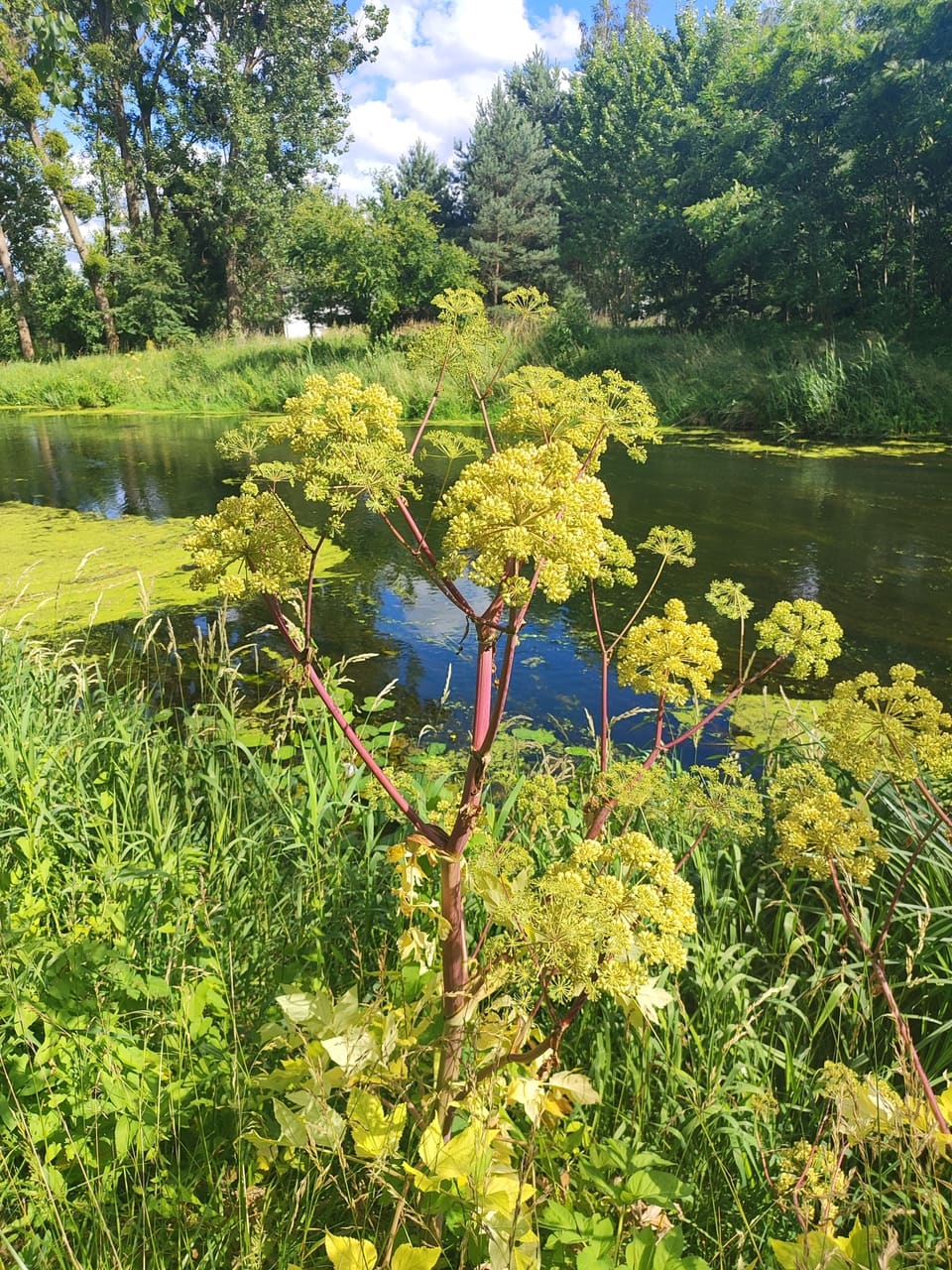
A tall plant with reddish stems and big rounded heads of yellow-green flowers, beside a pond
The whole plantKrzysztof DaszutaCC0
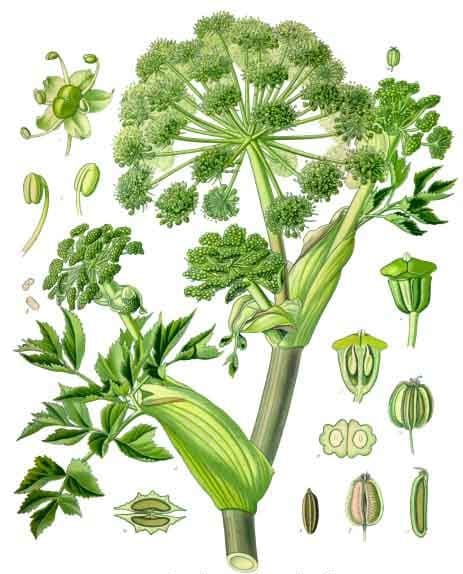
A color plate of a stout ribbed stem with a domed umbel and a sheathing leaf, the flower, the ovary and the ribbed seed drawn in section beside it
IllustrationFranz Eugen Köhler, Köhler's Medizinal-PflanzenPublic domain

About the plant

What it is and where it grows — not part of any germination protocol.

The plant

Habit
Herb, Herbaceous PerennialExtension Gardener Plant Toolbox
Habit
perennialPlants of the World Online
Height
3-6 ft0.9-1.8 mExtension Gardener Plant Toolbox
Spread
2-4 ft0.6-1.2 mExtension Gardener Plant Toolbox
Flower
Gold/Yellow, Green, Pink, WhiteExtension Gardener Plant Toolbox
Blooms
SummerExtension Gardener Plant Toolbox
Native range
Albania, Baltic States, Belarus, Bulgaria, Central European Russia, Denmark and elsewhereGBIF Backbone Taxonomy
Hardiness zones
5-8Extension Gardener Plant Toolbox

Growing conditions

Sun
Full sun; Partial ShadeExtension Gardener Plant Toolbox
Soil
Clay, Loam (Silt), SandExtension Gardener Plant Toolbox
Soil pH
Acid (<6.0), Neutral (6.0-8.0)Extension Gardener Plant Toolbox
Moisture
Moist, Occasionally WetExtension Gardener Plant Toolbox

Toxicity is noted only where a source states it. No note here is not a finding of safety.

Sources: Extension Gardener Plant Toolbox — NC State Extension; Plants of the World Online — Royal Botanic Gardens, Kew; GBIF Backbone Taxonomy — Global Biodiversity Information Facility.

Worth knowing

  • Grown as a vegetable and medicine from the 10th century, and popular in Scandinavia from the 12th. It flavors liqueurs such as Chartreuse and Bénédictine, and its stems are candied. Wikipedia: Angelica archangelica
  • It looks like several poisonous relatives, such as Conium and Heracleum, and should not be eaten unless it has been identified with absolute certainty. Wikipedia: Angelica archangelica

This source reports 5 treatments. All are shown.

Protocol 1

DerivedN. C. Deno, 1996

Difficulty Low Rated by us, not by the source.

Start around March 18, 2027 for a May 3 last frost.

  1. Sow and cover

    Temperature: 70°F 21°C Light: light

No stated waiting before sowing. Then 18 days to germinate.

98% germination in 10–18 days.

Seed Germination Theory and Practice, 1st Supplement — N. C. Deno, 1996 · 1st Supplement, Angelica p. 20Public domain
Show the original text
Angelica (Apiaceae). A. archangelica germ. 70L (98% in 10-18 d), 70 GA-3 (97% in 11-15 d), 70D (5%)-40(10%)-70D(33% in 4-15 d)-40(5%), 40-70D(18%)- 40(2%), and 46% in Nov.-Dec. and 31% in March-April in OT. The light requirement is simiiar to the two species reported in the 2nd Ed., and 70L is the best treatment. The seeds were all dead after 1 y of DS.
Seed Germination Theory and Practice, 1st Supplement, 1st Supplement, Angelica p. 20. Quoted exactly. Every value on this card comes from this record, except the difficulty rating, which is ours; the step names come from a fixed list.

Protocol 2

DerivedN. C. Deno, 1996

Difficulty Low Rated by us, not by the source.

Start around March 21, 2027 for a May 3 last frost.

  1. Gibberellic acid soak

  2. Sow and cover

    Temperature: 70°F 21°C

No stated waiting before sowing. Then 15 days to germinate.

97% germination in 11–15 days.

Seed Germination Theory and Practice, 1st Supplement — N. C. Deno, 1996 · 1st Supplement, Angelica p. 20Public domain
Show the original text
Angelica (Apiaceae). A. archangelica germ. 70L (98% in 10-18 d), 70 GA-3 (97% in 11-15 d), 70D (5%)-40(10%)-70D(33% in 4-15 d)-40(5%), 40-70D(18%)- 40(2%), and 46% in Nov.-Dec. and 31% in March-April in OT. The light requirement is simiiar to the two species reported in the 2nd Ed., and 70L is the best treatment. The seeds were all dead after 1 y of DS.
Seed Germination Theory and Practice, 1st Supplement, 1st Supplement, Angelica p. 20. Quoted exactly. Every value on this card comes from this record, except the difficulty rating, which is ours; the step names come from a fixed list.

Protocol 3

DerivedN. C. Deno, 1996

Difficulty High Rated by us, not by the source.

Start around September 23, 2027 for a May 3 last frost. Too late for spring 2027 — that needed starting on September 22, 2026.

  1. Warm moist stratification

    Duration: 90 daysTemperature: 70°F 21°C Light: dark

    5 germinated in this phase.

  2. Cold moist stratification

    Duration: 90 daysTemperature: 40°F 4°C

    10 germinated in this phase.

  3. Warm moist stratification

    Duration: 90 daysTemperature: 70°F 21°C Light: dark

  4. Cold moist stratification

    Duration: 90 daysTemperature: 40°F 4°C

    5 germinated in this phase.

Steps after step 3 run on after germination.

about 6 months from start to step 3. Germination happens during step 3, in 15 days.

33% germination in 4–15 days.

Seed Germination Theory and Practice, 1st Supplement — N. C. Deno, 1996 · 1st Supplement, Angelica p. 20Public domain
Show the original text
Angelica (Apiaceae). A. archangelica germ. 70L (98% in 10-18 d), 70 GA-3 (97% in 11-15 d), 70D (5%)-40(10%)-70D(33% in 4-15 d)-40(5%), 40-70D(18%)- 40(2%), and 46% in Nov.-Dec. and 31% in March-April in OT. The light requirement is simiiar to the two species reported in the 2nd Ed., and 70L is the best treatment. The seeds were all dead after 1 y of DS.
Seed Germination Theory and Practice, 1st Supplement, 1st Supplement, Angelica p. 20. Quoted exactly. Every value on this card comes from this record, except the difficulty rating, which is ours; the step names come from a fixed list.

Protocol 4

DerivedN. C. Deno, 1996

Difficulty Moderate Rated by us, not by the source.

  1. Sow outdoors and leave it

    Up in March-April.

No stated waiting before sowing.

31% germination.

This source doesn't state how long step 1 lasts.

Seed Germination Theory and Practice, 1st Supplement — N. C. Deno, 1996 · 1st Supplement, Angelica p. 20Public domain
Show the original text
Angelica (Apiaceae). A. archangelica germ. 70L (98% in 10-18 d), 70 GA-3 (97% in 11-15 d), 70D (5%)-40(10%)-70D(33% in 4-15 d)-40(5%), 40-70D(18%)- 40(2%), and 46% in Nov.-Dec. and 31% in March-April in OT. The light requirement is simiiar to the two species reported in the 2nd Ed., and 70L is the best treatment. The seeds were all dead after 1 y of DS.
Seed Germination Theory and Practice, 1st Supplement, 1st Supplement, Angelica p. 20. Quoted exactly. Every value on this card comes from this record, except the difficulty rating, which is ours; the step names come from a fixed list.

Protocol 5

DerivedN. C. Deno, 1996

Difficulty High Rated by us, not by the source.

Start around December 15, 2026 for a May 3 last frost.

  1. Cold moist stratification

    Duration: 90 daysTemperature: 40°F 4°C

  2. Warm moist stratification

    Duration: 90 daysTemperature: 70°F 21°C Light: dark

  3. Cold moist stratification

    Duration: 90 daysTemperature: 40°F 4°C

    2 germinated in this phase.

Steps after step 2 run on after germination.

about 3 months from start to step 2. Germination happens during step 2; time not stated, 21 days assumed.

18% germination.

Seed Germination Theory and Practice, 1st Supplement — N. C. Deno, 1996 · 1st Supplement, Angelica p. 20Public domain
Show the original text
Angelica (Apiaceae). A. archangelica germ. 70L (98% in 10-18 d), 70 GA-3 (97% in 11-15 d), 70D (5%)-40(10%)-70D(33% in 4-15 d)-40(5%), 40-70D(18%)- 40(2%), and 46% in Nov.-Dec. and 31% in March-April in OT. The light requirement is simiiar to the two species reported in the 2nd Ed., and 70L is the best treatment. The seeds were all dead after 1 y of DS.
Seed Germination Theory and Practice, 1st Supplement, 1st Supplement, Angelica p. 20. Quoted exactly. Every value on this card comes from this record, except the difficulty rating, which is ours; the step names come from a fixed list.

Germination trials

Readers’ own records of sowing this species, published after review. Share your trial · All trials

Add to My Garden

View species page