Deno’s GardenMy Garden

Carica papaya

Papaw · Papaya · Pape

Family CaricaceaeGenus Carica

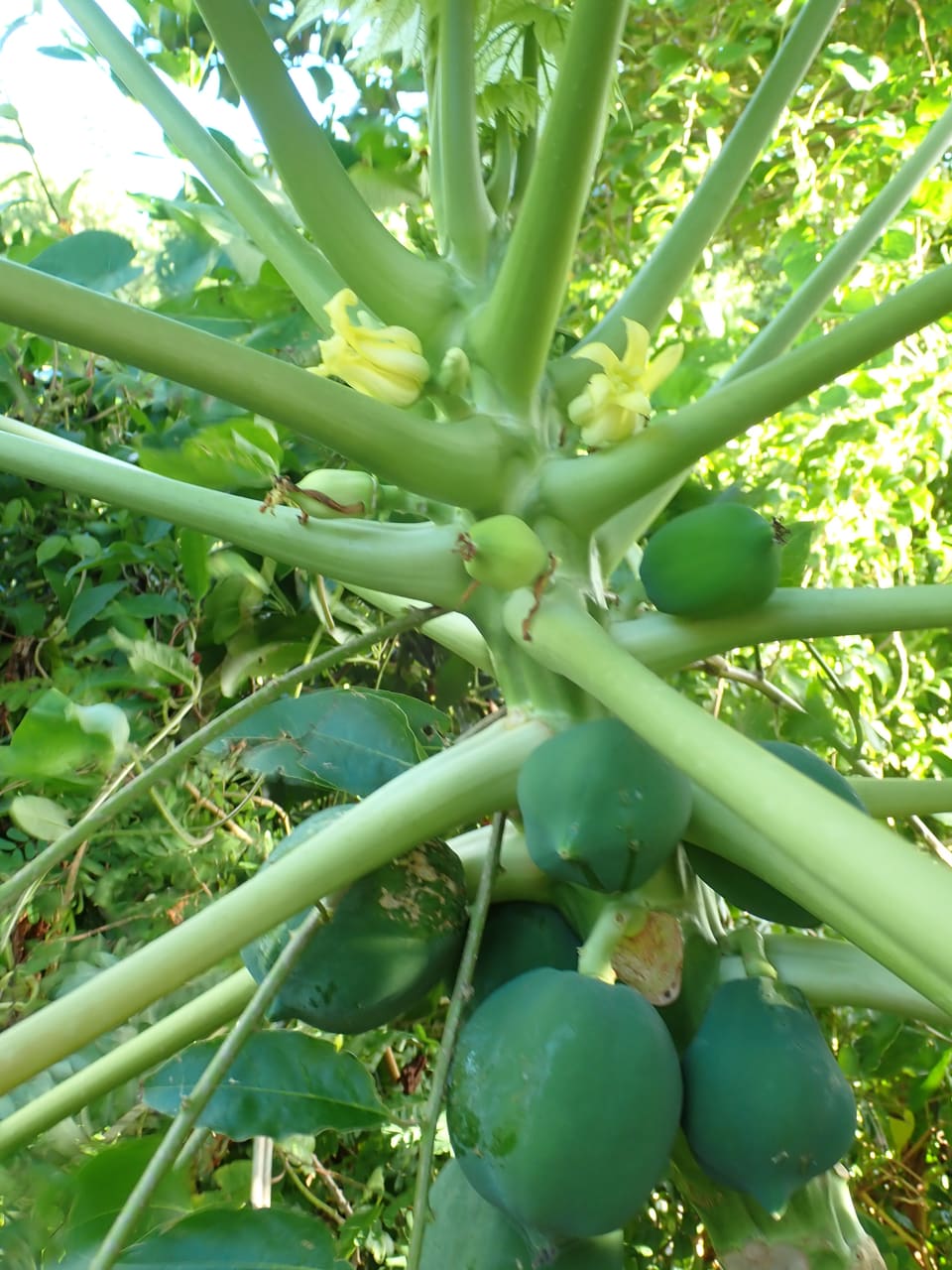
A cluster of green papaya fruits hanging from the trunk below long-stalked leaves and pale yellow flowers
FruitDon LoarieCC BY 4.0
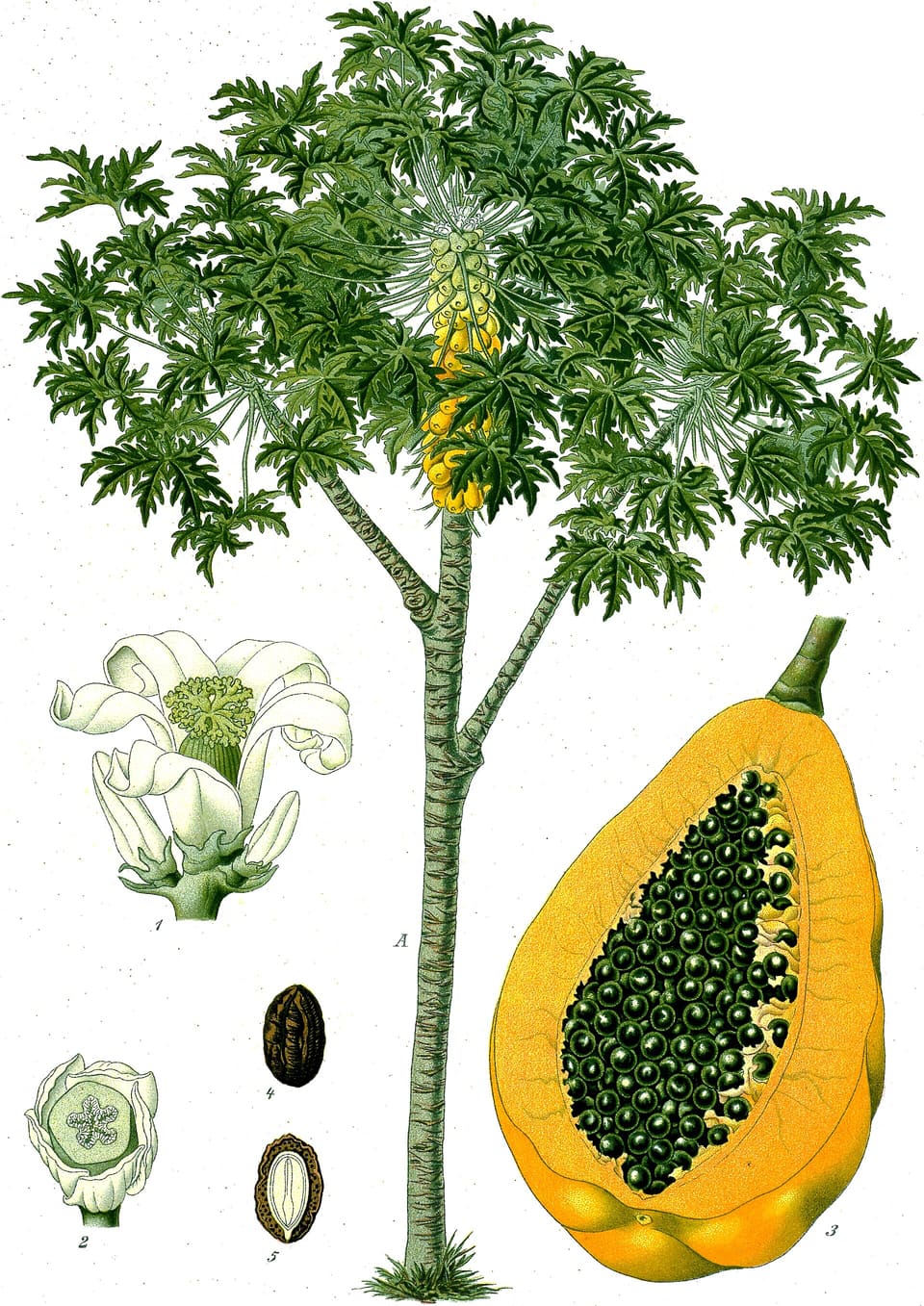
A color plate of a palm-like tree with lobed leaves and yellow fruit at the crown, with a flower, the fruit in cross-section packed with dark seeds, and single seeds drawn
IllustrationFranz Eugen Köhler, Köhler's Medizinal-PflanzenPublic domain

About the plant

What it is and where it grows — not part of any germination protocol.

The plant

Habit
treePlants of the World Online
Habit
Perennial, Shrub, TreePLANTS Database
Height
20.0 ft6.1 mPLANTS Database
Flower
WhitePLANTS Database
Blooms
IndeterminatePLANTS Database
Native range
Belize, Colombia, Costa Rica, El Salvador, Guatemala, Honduras and elsewhereGBIF Backbone Taxonomy

Growing conditions

Sun
Shade tolerance: HighPLANTS Database
Soil
Adapted to medium, fine textured soilsPLANTS Database
Soil pH
5.0-8.0PLANTS Database
Moisture
Moisture use: HighPLANTS Database
Watering
Drought tolerance: LowPLANTS Database

Toxicity is noted only where a source states it. No note here is not a finding of safety.

Sources: Plants of the World Online — Royal Botanic Gardens, Kew; PLANTS Database — USDA NRCS; GBIF Backbone Taxonomy — Global Biodiversity Information Facility.

Worth knowing

  • First domesticated in Mesoamerica. The green fruit contains papain, an enzyme used to tenderize meat. Wikipedia: Papaya
  • Papaya comes from the Arawakan languages of the West Indies. In Australia it may be called pawpaw, but the American pawpaw, Asimina triloba, is an unrelated plant. Wikipedia: Papaya

Two sources report 4 treatments between them. All are shown.

Protocol 1

DerivedN. C. Deno, 1998

Difficulty Moderate Rated by us, not by the source.

Start around March 16, 2027 for a May 3 last frost. Too late for spring 2027 — that needed starting on March 16, 2023.

  1. Dry storage

    Duration: 1460 daysTemperature: 70°F 21°C

  2. Sow and cover

    Temperature: 70°F 21°C Light: light

about 4 years from start to sowing. Then 21 days to germinate.

40% germination in 21 days.

Seed Germination Theory and Practice, 2nd Supplement — N. C. Deno, 1998 · 2nd Supplement, Carica p. 23Public domain
Show the original text
Carica (Caricaceae). C. papaya seeds DS 4 y and 5 y germ. 70L(40% in 3rd w) and 70D(none) similar to seeds DS G-2 y so that there is no sign of dying as yet. None germ. in 70D showing that the light requirement was unchanged.
Seed Germination Theory and Practice, 2nd Supplement, 2nd Supplement, Carica p. 23. Quoted exactly. Every value on this card comes from this record, except the difficulty rating, which is ours; the step names come from a fixed list.

Protocol 2

DerivedN. C. Deno, 1993

Difficulty Low Rated by us, not by the source.

Start around March 15, 2027 for a May 3 last frost.

  1. Clean the flesh off the seed

  2. Gibberellic acid soak

  3. Sow and cover

    Temperature: 70°F 21°C Light: dark

No stated waiting before sowing. Then 21 days to germinate.

95% germination in 21 days.

Seed Germination Theory and Practice, 2nd ed. — N. C. Deno, 1993 · Ch. 20, Carica p. 113Public domain
Show the original text
Carica (Caricaceae). C. papaya required WC (7 d) and either light or GA-3. Seeds germ.. 70L(43% in 2nd w), 70D GA-3(95% in 3rd w), and 70D(none), The photorequirement was surprising in view of the jet black color of the seeds. Part of the samples in 70D and 70L were treated with GA-3 after 4 w whereupon the remaining seeds germ. 90-100% in the 2nd wafter the GA-3 treatment. A prior 3m at 40 was nearly fatal as shown by 40-70L(10%), 40-70 GA-3(none), and 40-70D(none).
Seed Germination Theory and Practice, 2nd ed., Ch. 20, Carica p. 113. Quoted exactly. Every value on this card comes from this record, except the difficulty rating, which is ours; the step names come from a fixed list.

Protocol 3

DerivedN. C. Deno, 1993

Difficulty Moderate Rated by us, not by the source.

Start around March 22, 2027 for a May 3 last frost.

  1. Clean the flesh off the seed

  2. Sow and cover

    Temperature: 70°F 21°C Light: light

No stated waiting before sowing. Then 14 days to germinate.

43% germination in 14 days.

Seed Germination Theory and Practice, 2nd ed. — N. C. Deno, 1993 · Ch. 20, Carica p. 113Public domain
Show the original text
Carica (Caricaceae). C. papaya required WC (7 d) and either light or GA-3. Seeds germ.. 70L(43% in 2nd w), 70D GA-3(95% in 3rd w), and 70D(none), The photorequirement was surprising in view of the jet black color of the seeds. Part of the samples in 70D and 70L were treated with GA-3 after 4 w whereupon the remaining seeds germ. 90-100% in the 2nd wafter the GA-3 treatment. A prior 3m at 40 was nearly fatal as shown by 40-70L(10%), 40-70 GA-3(none), and 40-70D(none).
Seed Germination Theory and Practice, 2nd ed., Ch. 20, Carica p. 113. Quoted exactly. Every value on this card comes from this record, except the difficulty rating, which is ours; the step names come from a fixed list.

Protocol 4

DerivedN. C. Deno, 1993

Difficulty High Rated by us, not by the source.

Start around December 15, 2026 for a May 3 last frost.

  1. Clean the flesh off the seed

  2. Cold moist stratification

    Duration: 90 daysTemperature: 40°F 4°C

  3. Warm moist stratification

    Duration: 90 daysTemperature: 70°F 21°C Light: light

about 3 months from start to step 3. Germination happens during step 3; time not stated, 21 days assumed.
10% germination.

Seed Germination Theory and Practice, 2nd ed. — N. C. Deno, 1993 · Ch. 20, Carica p. 113Public domain
Show the original text
Carica (Caricaceae). C. papaya required WC (7 d) and either light or GA-3. Seeds germ.. 70L(43% in 2nd w), 70D GA-3(95% in 3rd w), and 70D(none), The photorequirement was surprising in view of the jet black color of the seeds. Part of the samples in 70D and 70L were treated with GA-3 after 4 w whereupon the remaining seeds germ. 90-100% in the 2nd wafter the GA-3 treatment. A prior 3m at 40 was nearly fatal as shown by 40-70L(10%), 40-70 GA-3(none), and 40-70D(none).
Seed Germination Theory and Practice, 2nd ed., Ch. 20, Carica p. 113. Quoted exactly. Every value on this card comes from this record, except the difficulty rating, which is ours; the step names come from a fixed list.

Germination trials

Readers’ own records of sowing this species, published after review. Share your trial · All trials

Add to My Garden

View species page