Deno’s GardenMy Garden

Frasera speciosa

Elkweed

Family GentianaceaeGenus Frasera

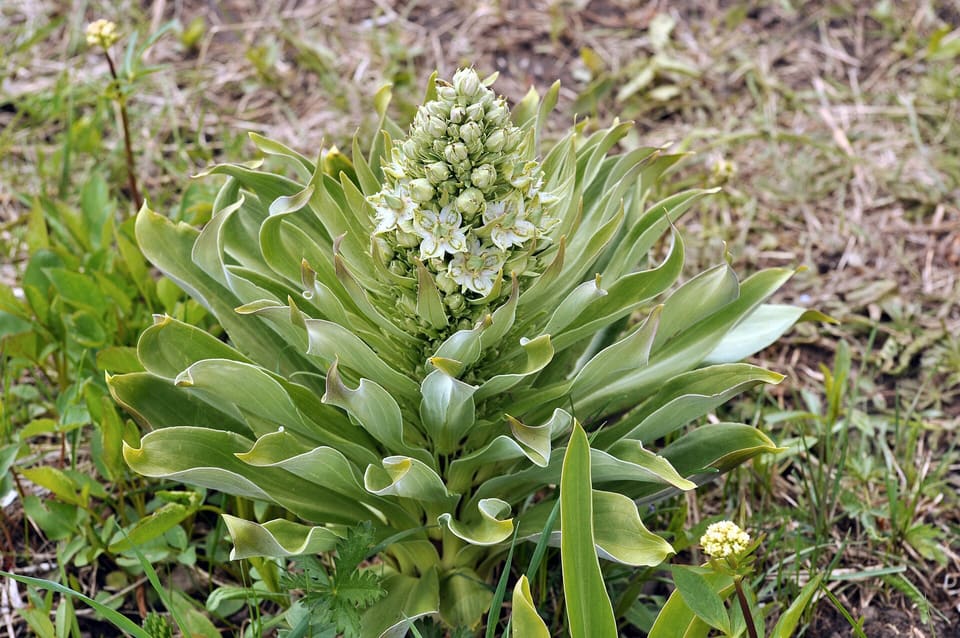
A stout green and white flower spike rising from a rosette of broad wavy blue-green leaves
The whole plantMike ClineCC0

About the plant

What it is and where it grows — not part of any germination protocol.

Habit
monocarpic perennialPlants of the World Online
Habit
Perennial, Forb/herbPLANTS Database
Flower
Pale yellowish greenFlora of North America
Native range
Native to the lower 48 statesPLANTS Database

Toxicity is noted only where a source states it. No note here is not a finding of safety.

Sources: Plants of the World Online — Royal Botanic Gardens, Kew; PLANTS Database — USDA NRCS; Flora of North America — Flora of North America Editorial Committee.

Worth knowing

  • It flowers once and dies, but may live for many years before it does: flowering plants average about 40 years old, and some live more than 80. Plants in an area bloom together. Wikipedia: Frasera speciosa
  • Thomas Walter named the genus in 1788 for the plant collector John Fraser. Other names include elkweed and monument plant. Wikipedia: Frasera speciosa

This source reports 4 treatments. All are shown.

Protocol 1

DerivedN. C. Deno, 1993

Difficulty Very high Rated by us, not by the source.

Sow around December 2026 — a date the source gives, not one counted back from a May 3 last frost.

  1. Sow outdoors and leave it

    Sown outdoors in December; up in April.

No stated waiting before sowing. Germination time not stated; 21 days assumed.

5% germination.

Seed Germination Theory and Practice, 2nd ed. — N. C. Deno, 1993 · Ch. 20, Frasera p. 143Public domain
Show the original text
Frasera (Gentianaceae). Germination extended over several cycles. Treatment with GA-3 was tried only on samples that had been subjected to a year of alternating 3 m cycles. There was no effect. F. speciosa placed outdoors in December germ. 5% in April and an additional 20% a year later. Seeds also germ. 40(1%)-70-40(0.5%)70(2%) and 70-40-70- 40(1%). . ,.
Seed Germination Theory and Practice, 2nd ed., Ch. 20, Frasera p. 143. Quoted exactly. Every value on this card comes from this record, except the difficulty rating, which is ours; the step names come from a fixed list.

Protocol 2

DerivedN. C. Deno, 1993

Difficulty Very high Rated by us, not by the source.

Start around March 15, 2027 for a May 3 last frost.

  1. Sow and cover

    Temperature: 70°F 21°C

No stated waiting before sowing. Germination time not stated; 21 days assumed.

2% germination.

Seed Germination Theory and Practice, 2nd ed. — N. C. Deno, 1993 · Ch. 20, Frasera p. 143Public domain
Show the original text
Frasera (Gentianaceae). Germination extended over several cycles. Treatment with GA-3 was tried only on samples that had been subjected to a year of alternating 3 m cycles. There was no effect. F. speciosa placed outdoors in December germ. 5% in April and an additional 20% a year later. Seeds also germ. 40(1%)-70-40(0.5%)70(2%) and 70-40-70- 40(1%). . ,.
Seed Germination Theory and Practice, 2nd ed., Ch. 20, Frasera p. 143. Quoted exactly. Every value on this card comes from this record, except the difficulty rating, which is ours; the step names come from a fixed list.

Protocol 3

DerivedN. C. Deno, 1993

Difficulty Very high Rated by us, not by the source.

Start around March 15, 2027 for a May 3 last frost.

  1. Cold moist stratification

    Duration: 90 daysTemperature: 40°F 4°C

  2. Warm moist stratification

    Duration: 90 daysTemperature: 70°F 21°C

  3. Cold moist stratification

    Duration: 90 daysTemperature: 40°F 4°C

Steps after step 1 run on after germination.

Germination happens during step 1; time not stated, 21 days assumed.

1% germination.

Seed Germination Theory and Practice, 2nd ed. — N. C. Deno, 1993 · Ch. 20, Frasera p. 143Public domain
Show the original text
Frasera (Gentianaceae). Germination extended over several cycles. Treatment with GA-3 was tried only on samples that had been subjected to a year of alternating 3 m cycles. There was no effect. F. speciosa placed outdoors in December germ. 5% in April and an additional 20% a year later. Seeds also germ. 40(1%)-70-40(0.5%)70(2%) and 70-40-70- 40(1%). . ,.
Seed Germination Theory and Practice, 2nd ed., Ch. 20, Frasera p. 143. Quoted exactly. Every value on this card comes from this record, except the difficulty rating, which is ours; the step names come from a fixed list.

Protocol 4

DerivedN. C. Deno, 1993

Difficulty Very high Rated by us, not by the source.

Start around June 19, 2027 for a May 3 last frost. Too late for spring 2027 — that needed starting on June 18, 2026.

  1. Warm moist stratification

    Duration: 90 daysTemperature: 70°F 21°C

  2. Cold moist stratification

    Duration: 90 daysTemperature: 40°F 4°C

  3. Warm moist stratification

    Duration: 90 daysTemperature: 70°F 21°C

  4. Cold moist stratification

    Duration: 90 daysTemperature: 40°F 4°C

about 9 months from start to step 4. Germination happens during step 4; time not stated, 21 days assumed.
1% germination.

Seed Germination Theory and Practice, 2nd ed. — N. C. Deno, 1993 · Ch. 20, Frasera p. 143Public domain
Show the original text
Frasera (Gentianaceae). Germination extended over several cycles. Treatment with GA-3 was tried only on samples that had been subjected to a year of alternating 3 m cycles. There was no effect. F. speciosa placed outdoors in December germ. 5% in April and an additional 20% a year later. Seeds also germ. 40(1%)-70-40(0.5%)70(2%) and 70-40-70- 40(1%). . ,.
Seed Germination Theory and Practice, 2nd ed., Ch. 20, Frasera p. 143. Quoted exactly. Every value on this card comes from this record, except the difficulty rating, which is ours; the step names come from a fixed list.

Germination trials

Readers’ own records of sowing this species, published after review. Share your trial · All trials

Add to My Garden

View species page