Deno’s GardenMy Garden

Maianthemum racemosum

False Solomon's-seal · False Spikenard · Feathery False Lily of the Valley

Family AsparagaceaeGenus Maianthemum

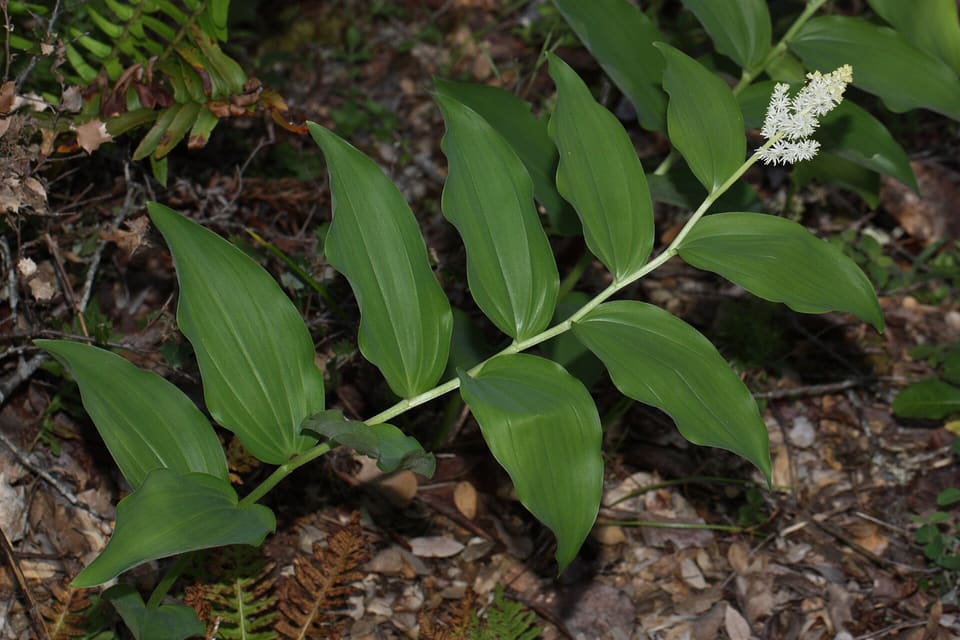
An arching stem of ribbed oval leaves ending in a plume of small white flowers, on the forest floor
The whole plantWalter Siegmund (talk)CC BY-SA 3.0

About the plant

What it is and where it grows — not part of any germination protocol.

Habit
rhizomatous geophytePlants of the World Online
Habit
Perennial, Forb/herbPLANTS Database
Flower
WhiteWikipedia
Native range
Alaska, Canada, lower 48 statesPLANTS Database

Toxicity is noted only where a source states it. No note here is not a finding of safety.

Sources: Plants of the World Online — Royal Botanic Gardens, Kew; PLANTS Database — USDA NRCS; Wikipedia — Wikipedia contributors.

Worth knowing

  • Found in every US state except Hawaii. The tender young shoots, stripped of their leaves and simmered, taste somewhat of asparagus. Wikipedia: Maianthemum racemosum

This source reports 4 treatments. All are shown.

Protocol 1

DerivedN. C. Deno, 1993

Difficulty Moderate Rated by us, not by the source.

Start around April 24, 2027 for a May 3 last frost. Too late for spring 2027 — that needed starting on April 23, 2026.

  1. Dry storage

    Duration: 180 days

  2. Cold moist stratification

    Duration: 90 daysTemperature: 40°F 4°C

  3. Warm moist stratification

    Duration: 90 daysTemperature: 70°F 21°C

about 9 months from start to step 3. Germination happens during step 3, in 77 days.

90% germination in 28–77 days.

Seed Germination Theory and Practice, 2nd ed. — N. C. Deno, 1993 · Ch. 20, Smilacina p. 215Public domain
Show the original text
Smilacina (Liliaceae). S. racemosa germ. 40-70(90% in 4-11 w) and 70-40- 70(5%) using seed DS 6 m at 70 or 40. Fresh seed ultimately germ. 50-82%, but germination was much extended as shown by 40-70(25%)-40-70(25%) and 70(10%)- 40-70(14%)-40-70(3%)-40-70(55% in 4-6 w). Both DS and fresh seeds germ. far better when sown at 40 with DS seed best. Germination is hypogeal. The radicle was allowed to develop to its full three inches at 70. Shifting to 40 for 4 m and back to 70 caused stems and leaves to develop in 25% of the seedlings, but the remaining 75% did not develop and most of these ultimately died by rotting of the terminal bud. More work is needed in determining conditions for destroying the growth inhibitors in the terminal bud. Treatment with GA-3 blocked germination.
Seed Germination Theory and Practice, 2nd ed., Ch. 20, Smilacina p. 215. Quoted exactly. Every value on this card comes from this record, except the difficulty rating, which is ours; the step names come from a fixed list.

Protocol 2

DerivedN. C. Deno, 1993

Difficulty High Rated by us, not by the source.

Start around September 1, 2027 for a May 3 last frost. Too late for spring 2027 — that needed starting on August 31, 2025.

  1. Warm moist stratification

    Duration: 90 daysTemperature: 70°F 21°C

    10 germinated in this phase.

  2. Cold moist stratification

    Duration: 90 daysTemperature: 40°F 4°C

  3. Warm moist stratification

    Duration: 90 daysTemperature: 70°F 21°C

    14 germinated in this phase.

  4. Cold moist stratification

    Duration: 90 daysTemperature: 40°F 4°C

  5. Warm moist stratification

    Duration: 90 daysTemperature: 70°F 21°C

    3 germinated in this phase.

  6. Cold moist stratification

    Duration: 90 daysTemperature: 40°F 4°C

  7. Warm moist stratification

    Duration: 90 daysTemperature: 70°F 21°C

about 18 months from start to step 7. Germination happens during step 7, in 42 days.

55% germination in 28–42 days.

Seed Germination Theory and Practice, 2nd ed. — N. C. Deno, 1993 · Ch. 20, Smilacina p. 215Public domain
Show the original text
Smilacina (Liliaceae). S. racemosa germ. 40-70(90% in 4-11 w) and 70-40- 70(5%) using seed DS 6 m at 70 or 40. Fresh seed ultimately germ. 50-82%, but germination was much extended as shown by 40-70(25%)-40-70(25%) and 70(10%)- 40-70(14%)-40-70(3%)-40-70(55% in 4-6 w). Both DS and fresh seeds germ. far better when sown at 40 with DS seed best. Germination is hypogeal. The radicle was allowed to develop to its full three inches at 70. Shifting to 40 for 4 m and back to 70 caused stems and leaves to develop in 25% of the seedlings, but the remaining 75% did not develop and most of these ultimately died by rotting of the terminal bud. More work is needed in determining conditions for destroying the growth inhibitors in the terminal bud. Treatment with GA-3 blocked germination.
Seed Germination Theory and Practice, 2nd ed., Ch. 20, Smilacina p. 215. Quoted exactly. Every value on this card comes from this record, except the difficulty rating, which is ours; the step names come from a fixed list.

Protocol 3

DerivedN. C. Deno, 1993

Difficulty High Rated by us, not by the source.

Start around December 15, 2026 for a May 3 last frost.

  1. Cold moist stratification

    Duration: 90 daysTemperature: 40°F 4°C

  2. Warm moist stratification

    Duration: 90 daysTemperature: 70°F 21°C

  3. Cold moist stratification

    Duration: 90 daysTemperature: 40°F 4°C

  4. Warm moist stratification

    Duration: 90 daysTemperature: 70°F 21°C

    25 germinated in this phase.

Steps after step 2 run on after germination.

about 3 months from start to step 2. Germination happens during step 2; time not stated, 21 days assumed.

25% germination.

Seed Germination Theory and Practice, 2nd ed. — N. C. Deno, 1993 · Ch. 20, Smilacina p. 215Public domain
Show the original text
Smilacina (Liliaceae). S. racemosa germ. 40-70(90% in 4-11 w) and 70-40- 70(5%) using seed DS 6 m at 70 or 40. Fresh seed ultimately germ. 50-82%, but germination was much extended as shown by 40-70(25%)-40-70(25%) and 70(10%)- 40-70(14%)-40-70(3%)-40-70(55% in 4-6 w). Both DS and fresh seeds germ. far better when sown at 40 with DS seed best. Germination is hypogeal. The radicle was allowed to develop to its full three inches at 70. Shifting to 40 for 4 m and back to 70 caused stems and leaves to develop in 25% of the seedlings, but the remaining 75% did not develop and most of these ultimately died by rotting of the terminal bud. More work is needed in determining conditions for destroying the growth inhibitors in the terminal bud. Treatment with GA-3 blocked germination.
Seed Germination Theory and Practice, 2nd ed., Ch. 20, Smilacina p. 215. Quoted exactly. Every value on this card comes from this record, except the difficulty rating, which is ours; the step names come from a fixed list.

Protocol 4

DerivedN. C. Deno, 1993

Difficulty Very high Rated by us, not by the source.

Start around March 21, 2027 for a May 3 last frost. Too late for spring 2027 — that needed starting on March 20, 2026.

  1. Dry storage

    Duration: 180 days

  2. Warm moist stratification

    Duration: 90 daysTemperature: 70°F 21°C

  3. Cold moist stratification

    Duration: 90 daysTemperature: 40°F 4°C

  4. Warm moist stratification

    Duration: 90 daysTemperature: 70°F 21°C

about 12 months from start to step 4. Germination happens during step 4; time not stated, 21 days assumed.
5% germination.

Seed Germination Theory and Practice, 2nd ed. — N. C. Deno, 1993 · Ch. 20, Smilacina p. 215Public domain
Show the original text
Smilacina (Liliaceae). S. racemosa germ. 40-70(90% in 4-11 w) and 70-40- 70(5%) using seed DS 6 m at 70 or 40. Fresh seed ultimately germ. 50-82%, but germination was much extended as shown by 40-70(25%)-40-70(25%) and 70(10%)- 40-70(14%)-40-70(3%)-40-70(55% in 4-6 w). Both DS and fresh seeds germ. far better when sown at 40 with DS seed best. Germination is hypogeal. The radicle was allowed to develop to its full three inches at 70. Shifting to 40 for 4 m and back to 70 caused stems and leaves to develop in 25% of the seedlings, but the remaining 75% did not develop and most of these ultimately died by rotting of the terminal bud. More work is needed in determining conditions for destroying the growth inhibitors in the terminal bud. Treatment with GA-3 blocked germination.
Seed Germination Theory and Practice, 2nd ed., Ch. 20, Smilacina p. 215. Quoted exactly. Every value on this card comes from this record, except the difficulty rating, which is ours; the step names come from a fixed list.

Germination trials

Readers’ own records of sowing this species, published after review. Share your trial · All trials

Add to My Garden

View species page