+ Add to My Garden
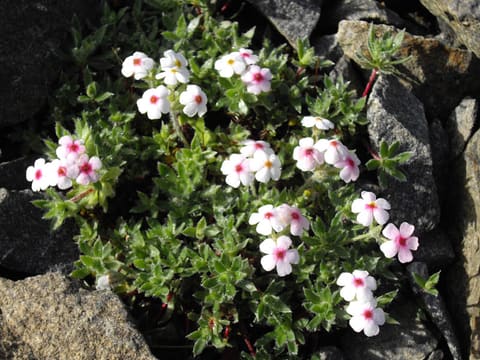
Flower Ghislain118 http://www.fleurs-des-montagnes.net CC BY-SA 3.0 About the plant What it is and where it grows — not part of any germination protocol.
Habit perennial Plants of the World Online
Flower Pink, white Read from the photograph on this page
Native range Afghanistan, Albania, Austria, Bulgaria, Central European Russia, France and elsewhere GBIF Backbone Taxonomy Toxicity is noted only where a source states it. No note here is not a finding of safety.
Sources: Plants of the World Online — Royal Botanic Gardens, Kew; Read from the photograph on this page — Deno's Garden; GBIF Backbone Taxonomy — Global Biodiversity Information Facility.
Worth knowing This alpine rock jasmine of the mountains of Europe and Asia is widely grown in rock gardens. Its Himalayan form, var. jacquemontii, from above 3,500 m, spreads by runners into large mats and has red-purple flowers. Wikipedia: Androsace villosa This source reports two treatments. Both are shown.
Protocol 1 N. C. Deno, 1993 Difficulty Moderate Rated by us, not by the source.
Start around December 8, 2026 for a May 3 last frost.
1 Cold moist stratification
Duration: 90 days · Temperature: 40°F 4°C
2 Warm moist stratification
Duration: 90 days · Temperature: 70°F 21°C
about 3 months from start to step 2. Germination happens during step 2, in 28 days.
75% germination in 14–28 days.
Seed Germination Theory and Practice, 2nd ed. — N. C. Deno, 1993 · Ch. 20, Androsace p. 93Public domain Show the original text Androsace (Primulaceae). The book "Androsace? by G.F. Smith and D. Lowe is devoted entirely to the genus. The only specific information on seed germination is that a low T cycle is not necessary which is not entirely in accord with the present work. The genus is divided into four sections: Pseudoprimula (P) which resemble Primula, Chamaejasme (C) which are mats of rosettes spreading by runners, Aretia (Ar) which are high alpine cushions, and Andraspis (An) which are winter annuals of lower elevation. The section is indicated for each species. Most of the data was obtained before the standardization of experiments. A. villosa (C) germ. a few in the 10th w at 70. A. villosa var. congesté (C) germ. 70(1/5 on 14th d) and 40-70(3/4 in 2-4 w). Seed Germination Theory and Practice, 2nd ed., Ch. 20, Androsace p. 93. Quoted exactly. Every value on this card comes from this record, except the difficulty rating, which is ours; the step names come from a fixed list. Protocol 2 N. C. Deno, 1993 Difficulty High Rated by us, not by the source.
Start around March 22, 2027 for a May 3 last frost.
1 Sow and cover
Temperature: 70°F 21°C
No stated waiting before sowing. Then 14 days to germinate.
20% germination in 14 days.
Seed Germination Theory and Practice, 2nd ed. — N. C. Deno, 1993 · Ch. 20, Androsace p. 93Public domain Show the original text Androsace (Primulaceae). The book "Androsace? by G.F. Smith and D. Lowe is devoted entirely to the genus. The only specific information on seed germination is that a low T cycle is not necessary which is not entirely in accord with the present work. The genus is divided into four sections: Pseudoprimula (P) which resemble Primula, Chamaejasme (C) which are mats of rosettes spreading by runners, Aretia (Ar) which are high alpine cushions, and Andraspis (An) which are winter annuals of lower elevation. The section is indicated for each species. Most of the data was obtained before the standardization of experiments. A. villosa (C) germ. a few in the 10th w at 70. A. villosa var. congesté (C) germ. 70(1/5 on 14th d) and 40-70(3/4 in 2-4 w). Seed Germination Theory and Practice, 2nd ed., Ch. 20, Androsace p. 93. Quoted exactly. Every value on this card comes from this record, except the difficulty rating, which is ours; the step names come from a fixed list. How each step is done , in Deno’s words, and what Verified and Derived mean.
Germination trials Readers’ own records of sowing this species, published after review. Share your trial · All trials
No trials shared for this species yet.