+ Add to My Garden
About the plant What it is and where it grows — not part of any germination protocol.
Habit tuberous geophyte Plants of the World Online
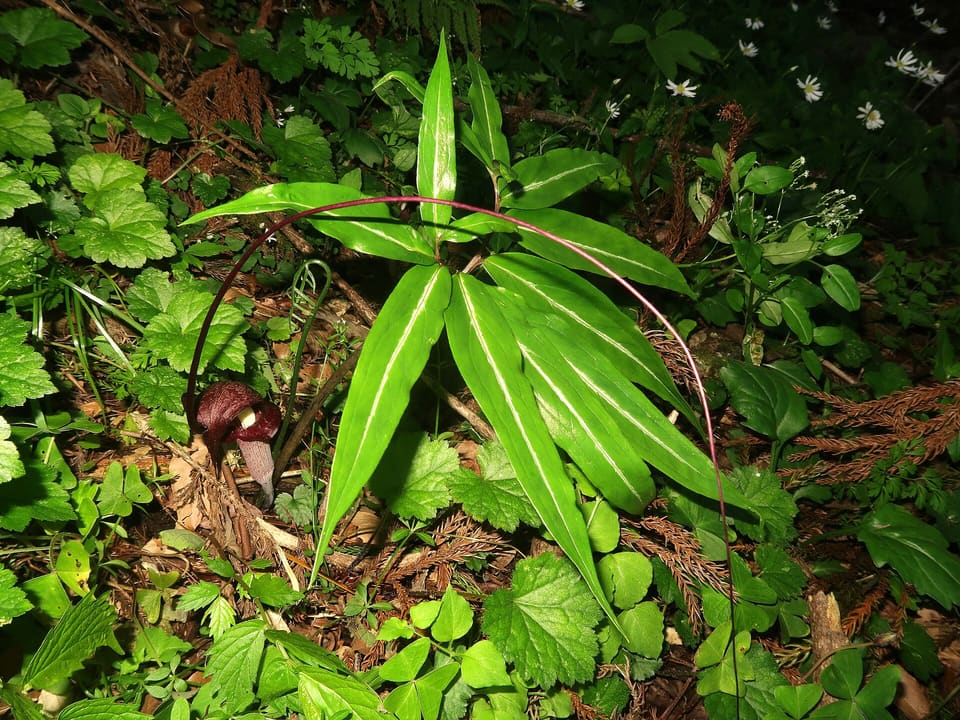
Flower Dark maroon Read from the photograph on this page
Native range Japan, Korea GBIF Backbone Taxonomy Toxicity is noted only where a source states it. No note here is not a finding of safety.
Sources: Plants of the World Online — Royal Botanic Gardens, Kew; Read from the photograph on this page — Deno's Garden; GBIF Backbone Taxonomy — Global Biodiversity Information Facility.
Worth knowing Asian jack-in-the-pulpit, from Japan, southern Korea and Taiwan, is poisonous, as every part of it contains calcium oxalate. Wikipedia: Arisaema thunbergii This source reports 4 treatments. All are shown.
Protocol 1 N. C. Deno, 1993 Difficulty Low Rated by us, not by the source.
Start around March 8, 2027 for a May 3 last frost.
1 Sow and cover
Temperature: 79°F 26°C
No stated waiting before sowing. Then 28 days to germinate.
100% germination in 14–28 days.
Seed Germination Theory and Practice, 2nd ed. — N. C. Deno, 1993 · Ch. 20, Arisaema p. 100Public domain Show the original text Arisaema (Araceae). The Asiatic species were received as dried berries in midwinter and germ. readily at 70 after WC for 7 d. The American species exhibited complex behavior. Germination is hypogeal in all species. The seed forms a corm and root system before sending up the single true leaf. This first true leaf is a single leaflet in A. thunbergii germ. readily, but difficulties were encountered in getting the trifoliate leaf to develop. The majority of seedlings ultimately rotted and never developed a leaf. Seed received in December in dried fruit germ. 79(100% in 2-4 w) and 40(20% in 9-12 w) -70(80% in 1-7 d). Leaf development was erratic. A few seedlings developed the leaf at 70 in 2-4 w after germination, but the majority did not. Shifting the seedlings to 40 for 3 m and back to 70 led to a few seedlings developing a leaf, but again the majority did not. Seed kept an additional 6 m at 40 in the dried fruit germ. 70(81% in 2-4 w)-40(12%) and 40(82% in 5-12 w)-70(6%). These seedlings produced a system of branching roots up to 3 inches long, but the roots were very thin and colorless. On shifting to 70, these fine roots died back to the tuber, and leaves failed to develop over several alternating cycles. Seed Germination Theory and Practice, 2nd ed., Ch. 20, Arisaema p. 100. Quoted exactly. Every value on this card comes from this record, except the difficulty rating, which is ours; the step names come from a fixed list. Protocol 2 N. C. Deno, 1993 Difficulty Moderate Rated by us, not by the source.
Start around January 11, 2027 for a May 3 last frost.
1 Cold moist stratification
Duration: 90 days · Temperature: 40°F 4°C
2 Warm moist stratification
Duration: 90 days · Temperature: 70°F 21°C
6 germinated in this phase.
Steps after step 1 run on after germination.
Germination happens during step 1, in 84 days.
82% germination in 35–84 days.
Seed Germination Theory and Practice, 2nd ed. — N. C. Deno, 1993 · Ch. 20, Arisaema p. 100Public domain Show the original text Arisaema (Araceae). The Asiatic species were received as dried berries in midwinter and germ. readily at 70 after WC for 7 d. The American species exhibited complex behavior. Germination is hypogeal in all species. The seed forms a corm and root system before sending up the single true leaf. This first true leaf is a single leaflet in A. thunbergii germ. readily, but difficulties were encountered in getting the trifoliate leaf to develop. The majority of seedlings ultimately rotted and never developed a leaf. Seed received in December in dried fruit germ. 79(100% in 2-4 w) and 40(20% in 9-12 w) -70(80% in 1-7 d). Leaf development was erratic. A few seedlings developed the leaf at 70 in 2-4 w after germination, but the majority did not. Shifting the seedlings to 40 for 3 m and back to 70 led to a few seedlings developing a leaf, but again the majority did not. Seed kept an additional 6 m at 40 in the dried fruit germ. 70(81% in 2-4 w)-40(12%) and 40(82% in 5-12 w)-70(6%). These seedlings produced a system of branching roots up to 3 inches long, but the roots were very thin and colorless. On shifting to 70, these fine roots died back to the tuber, and leaves failed to develop over several alternating cycles. Seed Germination Theory and Practice, 2nd ed., Ch. 20, Arisaema p. 100. Quoted exactly. Every value on this card comes from this record, except the difficulty rating, which is ours; the step names come from a fixed list. Protocol 3 N. C. Deno, 1993 Difficulty Moderate Rated by us, not by the source.
Start around March 8, 2027 for a May 3 last frost.
1 Warm moist stratification
Duration: 90 days · Temperature: 70°F 21°C
2 Cold moist stratification
Duration: 90 days · Temperature: 40°F 4°C
12 germinated in this phase.
Steps after step 1 run on after germination.
Germination happens during step 1, in 28 days.
81% germination in 14–28 days.
Seed Germination Theory and Practice, 2nd ed. — N. C. Deno, 1993 · Ch. 20, Arisaema p. 100Public domain Show the original text Arisaema (Araceae). The Asiatic species were received as dried berries in midwinter and germ. readily at 70 after WC for 7 d. The American species exhibited complex behavior. Germination is hypogeal in all species. The seed forms a corm and root system before sending up the single true leaf. This first true leaf is a single leaflet in A. thunbergii germ. readily, but difficulties were encountered in getting the trifoliate leaf to develop. The majority of seedlings ultimately rotted and never developed a leaf. Seed received in December in dried fruit germ. 79(100% in 2-4 w) and 40(20% in 9-12 w) -70(80% in 1-7 d). Leaf development was erratic. A few seedlings developed the leaf at 70 in 2-4 w after germination, but the majority did not. Shifting the seedlings to 40 for 3 m and back to 70 led to a few seedlings developing a leaf, but again the majority did not. Seed kept an additional 6 m at 40 in the dried fruit germ. 70(81% in 2-4 w)-40(12%) and 40(82% in 5-12 w)-70(6%). These seedlings produced a system of branching roots up to 3 inches long, but the roots were very thin and colorless. On shifting to 70, these fine roots died back to the tuber, and leaves failed to develop over several alternating cycles. Seed Germination Theory and Practice, 2nd ed., Ch. 20, Arisaema p. 100. Quoted exactly. Every value on this card comes from this record, except the difficulty rating, which is ours; the step names come from a fixed list. Protocol 4 N. C. Deno, 1993 Difficulty Moderate Rated by us, not by the source.
Start around December 29, 2026 for a May 3 last frost.
1 Cold moist stratification
Duration: 90 days · Temperature: 40°F 4°C
20 germinated in this phase.
2 Warm moist stratification
Duration: 90 days · Temperature: 70°F 21°C
about 3 months from start to step 2. Germination happens during step 2, in 7 days.
80% germination in 1–7 days.
Seed Germination Theory and Practice, 2nd ed. — N. C. Deno, 1993 · Ch. 20, Arisaema p. 100Public domain Show the original text Arisaema (Araceae). The Asiatic species were received as dried berries in midwinter and germ. readily at 70 after WC for 7 d. The American species exhibited complex behavior. Germination is hypogeal in all species. The seed forms a corm and root system before sending up the single true leaf. This first true leaf is a single leaflet in A. thunbergii germ. readily, but difficulties were encountered in getting the trifoliate leaf to develop. The majority of seedlings ultimately rotted and never developed a leaf. Seed received in December in dried fruit germ. 79(100% in 2-4 w) and 40(20% in 9-12 w) -70(80% in 1-7 d). Leaf development was erratic. A few seedlings developed the leaf at 70 in 2-4 w after germination, but the majority did not. Shifting the seedlings to 40 for 3 m and back to 70 led to a few seedlings developing a leaf, but again the majority did not. Seed kept an additional 6 m at 40 in the dried fruit germ. 70(81% in 2-4 w)-40(12%) and 40(82% in 5-12 w)-70(6%). These seedlings produced a system of branching roots up to 3 inches long, but the roots were very thin and colorless. On shifting to 70, these fine roots died back to the tuber, and leaves failed to develop over several alternating cycles. Seed Germination Theory and Practice, 2nd ed., Ch. 20, Arisaema p. 100. Quoted exactly. Every value on this card comes from this record, except the difficulty rating, which is ours; the step names come from a fixed list. How each step is done , in Deno’s words, and what Verified and Derived mean.
Germination trials Readers’ own records of sowing this species, published after review. Share your trial · All trials
No trials shared for this species yet.