Balsamorhiza hookeri
Hairy Balsamroot · Hooker's Balsamroot · Cutleaf Balsamroot
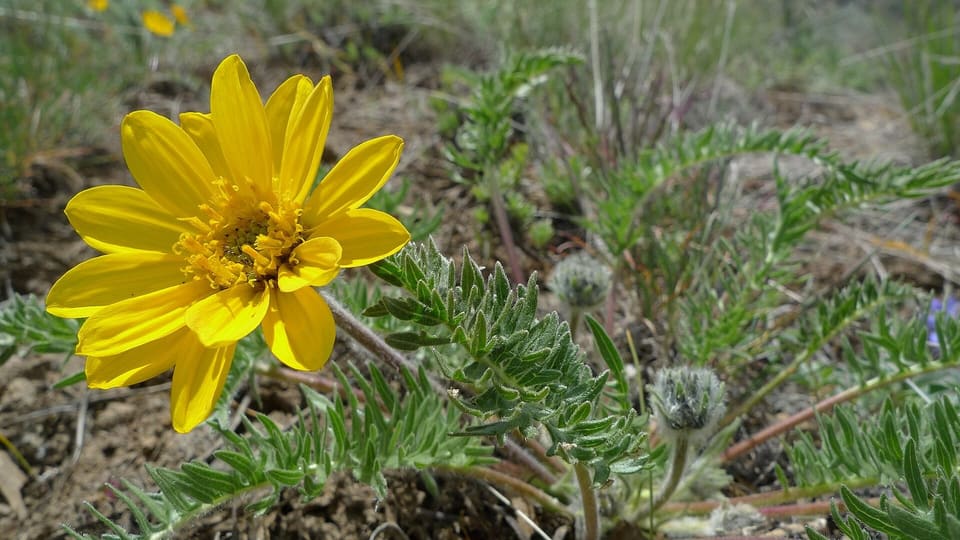

About the plant
What it is and where it grows — not part of any germination protocol.
The plant
- Habit
- perennialPlants of the World Online
- Habit
- Perennial, Forb/herbPLANTS Database
- Height
- 1.0 ft30 cmPLANTS Database
- Flower
- YellowPLANTS Database
- Blooms
- Mid SpringPLANTS Database
- Native range
- California, Idaho, Nevada, Oregon, Utah, WashingtonGBIF Backbone Taxonomy
Growing conditions
- Sun
- Shade tolerance: MediumPLANTS Database
- Soil
- Adapted to coarse, medium, fine textured soilsPLANTS Database
- Soil pH
- 6.6-9.0PLANTS Database
- Moisture
- Moisture use: MediumPLANTS Database
- Watering
- Drought tolerance: MediumPLANTS Database
Toxicity is noted only where a source states it. No note here is not a finding of safety.
Sources: Plants of the World Online — Royal Botanic Gardens, Kew; PLANTS Database — USDA NRCS; GBIF Backbone Taxonomy — Global Biodiversity Information Facility.
Worth knowing
- Hooker's balsamroot grows in rockier places than its cousin, arrowleaf balsamroot, and the two hybridize, giving plants with arrow-shaped but deeply divided leaves. Native peoples have long used balsamroots as food and medicine. Wikipedia: Balsamorhiza hookeri
This source reports two treatments. Both are shown.
Protocol 1
DerivedN. C. Deno, 1993Difficulty Moderate
Start around March 27, 2027 for a May 3 last frost.
Sow and cover
Temperature: 70°F 21°C
No stated waiting before sowing. Then 9 days to germinate.
33% germination in 5–9 days.
Protocol 2
DerivedN. C. Deno, 1993Cold moist stratification
Temperature: 40°F 4°C
failed to germinate after 4 cycles
Germination happens during step 1.
0% germination.
This source doesn't state how long step 1 lasts.
How each step is done, in Deno’s words, and what Verified and Derived mean.
Germination trials
Readers’ own records of sowing this species, published after review. Share your trial · All trials
No trials shared for this species yet.