Deno’s GardenMy Garden

Diplacus grandiflorus

Largeflower Bush Monkeyflower

Family PhrymaceaeGenus Diplacus

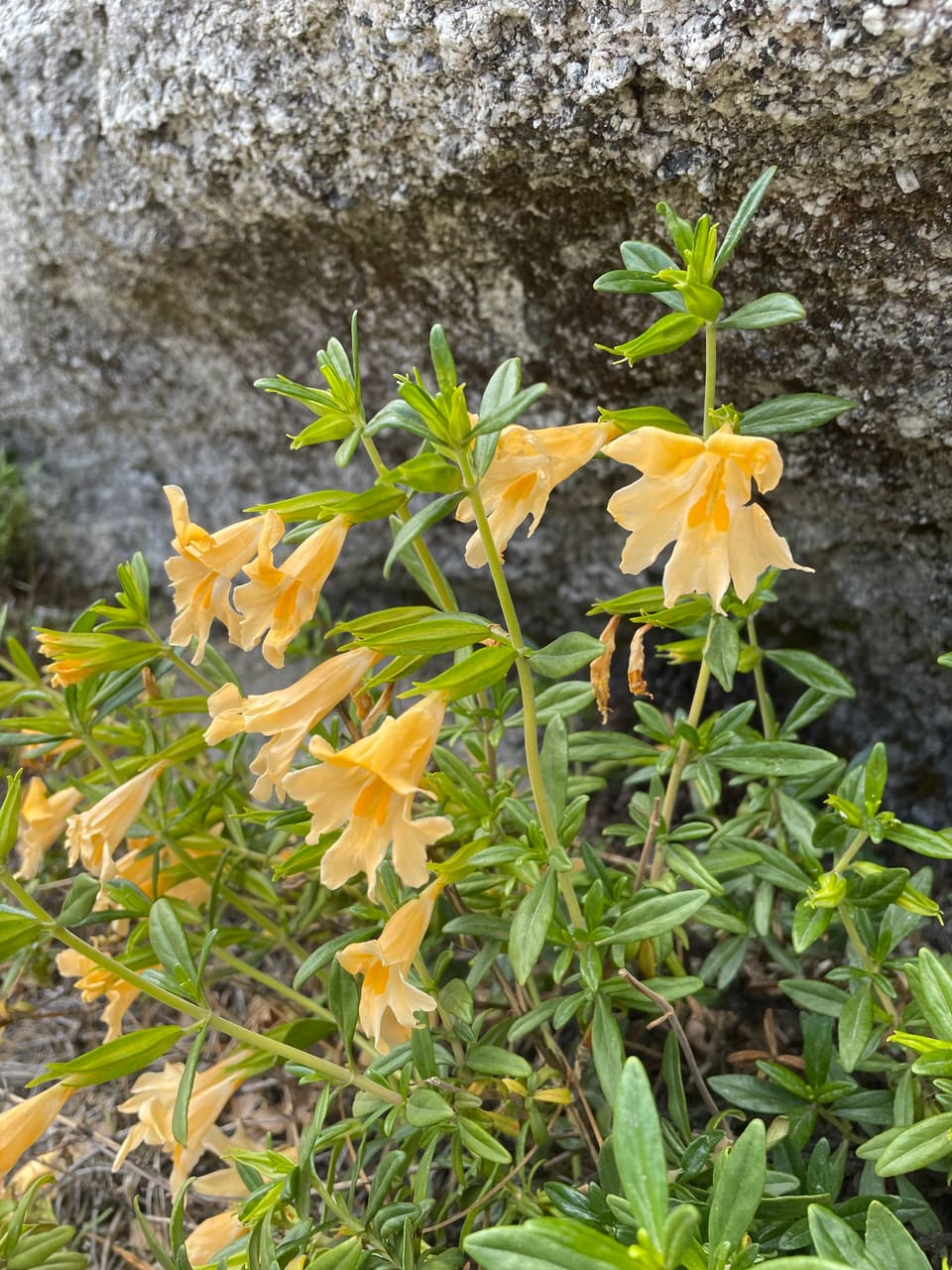
Apricot two-lipped trumpet flowers with flared mouths, opening along leafy stems that sprawl over gray granite.
Flower(c) Amelia Tauber, some rights reserved (CC BY)CC BY 4.0

About the plant

What it is and where it grows — not part of any germination protocol.

Habit
subshrub or shrubPlants of the World Online
Habit
Perennial, Shrub, SubshrubPLANTS Database
Flower
Pale orangeRead from the photograph on this page
Native range
Native to the lower 48 statesPLANTS Database

Toxicity is noted only where a source states it. No note here is not a finding of safety.

Sources: Plants of the World Online — Royal Botanic Gardens, Kew; PLANTS Database — USDA NRCS; Read from the photograph on this page — Deno's Garden.

Worth knowing

  • The large-flowered bush-monkeyflower is endemic to the northern Sierra Nevada of California, growing on steep canyon banks and rocky hillsides. Lindley and Paxton first described it in 1852. Wikipedia: Diplacus grandiflorus

This source reports 4 treatments. All are shown.

Protocol 1

DerivedN. C. Deno, 1993

Difficulty Low Rated by us, not by the source.

Start around March 15, 2027 for a May 3 last frost.

  1. Sow and cover

    Temperature: 70°F 21°C Light: light

No stated waiting before sowing. Then 21 days to germinate.

100% germination in 11–21 days.

Seed Germination Theory and Practice, 2nd ed. — N. C. Deno, 1993 · Ch. 20, Diplacus p. 134Public domain
Show the original text
Diplacus (Schrophulariaceae). This genus could be included in Mimulus. D. bifidus germ. largely in light at 70 as shown by 70L(100% in 11-21 d) and 70D(5%). After 2 m in 70D the seed was shifted to light whereupon the remaining 95% germ. in 7-26 d showing that the 2 m in 70D had no effect. There was some germination in the dark at 40 as shown by 40(12%)-70L(20%) and 40(12%)- 70D(none). Note that the 3 m at 40 lowered the overall percent germination showing that this treatment led to significant deterioration of the seed.
Seed Germination Theory and Practice, 2nd ed., Ch. 20, Diplacus p. 134. Quoted exactly. Every value on this card comes from this record, except the difficulty rating, which is ours; the step names come from a fixed list.

Protocol 2

DerivedN. C. Deno, 1993

Difficulty High Rated by us, not by the source.

Start around December 15, 2026 for a May 3 last frost.

  1. Cold moist stratification

    Duration: 90 daysTemperature: 40°F 4°C

    12 germinated in this phase.

  2. Warm moist stratification

    Duration: 90 daysTemperature: 70°F 21°C Light: light

about 3 months from start to step 2. Germination happens during step 2; time not stated, 21 days assumed.

20% germination.

Seed Germination Theory and Practice, 2nd ed. — N. C. Deno, 1993 · Ch. 20, Diplacus p. 134Public domain
Show the original text
Diplacus (Schrophulariaceae). This genus could be included in Mimulus. D. bifidus germ. largely in light at 70 as shown by 70L(100% in 11-21 d) and 70D(5%). After 2 m in 70D the seed was shifted to light whereupon the remaining 95% germ. in 7-26 d showing that the 2 m in 70D had no effect. There was some germination in the dark at 40 as shown by 40(12%)-70L(20%) and 40(12%)- 70D(none). Note that the 3 m at 40 lowered the overall percent germination showing that this treatment led to significant deterioration of the seed.
Seed Germination Theory and Practice, 2nd ed., Ch. 20, Diplacus p. 134. Quoted exactly. Every value on this card comes from this record, except the difficulty rating, which is ours; the step names come from a fixed list.

Protocol 3

DerivedN. C. Deno, 1993

Difficulty High Rated by us, not by the source.

Start around March 15, 2027 for a May 3 last frost.

  1. Cold moist stratification

    Duration: 90 daysTemperature: 40°F 4°C

  2. Warm moist stratification

    Duration: 90 daysTemperature: 70°F 21°C Light: dark

Steps after step 1 run on after germination.

Germination happens during step 1; time not stated, 21 days assumed.

12% germination.

Seed Germination Theory and Practice, 2nd ed. — N. C. Deno, 1993 · Ch. 20, Diplacus p. 134Public domain
Show the original text
Diplacus (Schrophulariaceae). This genus could be included in Mimulus. D. bifidus germ. largely in light at 70 as shown by 70L(100% in 11-21 d) and 70D(5%). After 2 m in 70D the seed was shifted to light whereupon the remaining 95% germ. in 7-26 d showing that the 2 m in 70D had no effect. There was some germination in the dark at 40 as shown by 40(12%)-70L(20%) and 40(12%)- 70D(none). Note that the 3 m at 40 lowered the overall percent germination showing that this treatment led to significant deterioration of the seed.
Seed Germination Theory and Practice, 2nd ed., Ch. 20, Diplacus p. 134. Quoted exactly. Every value on this card comes from this record, except the difficulty rating, which is ours; the step names come from a fixed list.

Protocol 4

DerivedN. C. Deno, 1993

Difficulty Very high Rated by us, not by the source.

Start around March 15, 2027 for a May 3 last frost.

  1. Sow and cover

    Temperature: 70°F 21°C Light: dark

No stated waiting before sowing. Germination time not stated; 21 days assumed.
5% germination.

Seed Germination Theory and Practice, 2nd ed. — N. C. Deno, 1993 · Ch. 20, Diplacus p. 134Public domain
Show the original text
Diplacus (Schrophulariaceae). This genus could be included in Mimulus. D. bifidus germ. largely in light at 70 as shown by 70L(100% in 11-21 d) and 70D(5%). After 2 m in 70D the seed was shifted to light whereupon the remaining 95% germ. in 7-26 d showing that the 2 m in 70D had no effect. There was some germination in the dark at 40 as shown by 40(12%)-70L(20%) and 40(12%)- 70D(none). Note that the 3 m at 40 lowered the overall percent germination showing that this treatment led to significant deterioration of the seed.
Seed Germination Theory and Practice, 2nd ed., Ch. 20, Diplacus p. 134. Quoted exactly. Every value on this card comes from this record, except the difficulty rating, which is ours; the step names come from a fixed list.

Germination trials

Readers’ own records of sowing this species, published after review. Share your trial · All trials

Add to My Garden

View species page