Deno’s GardenMy Garden

Paeonia brownii

Brown's Peony · Western Peony
Family PaeoniaceaeGenus Paeonia

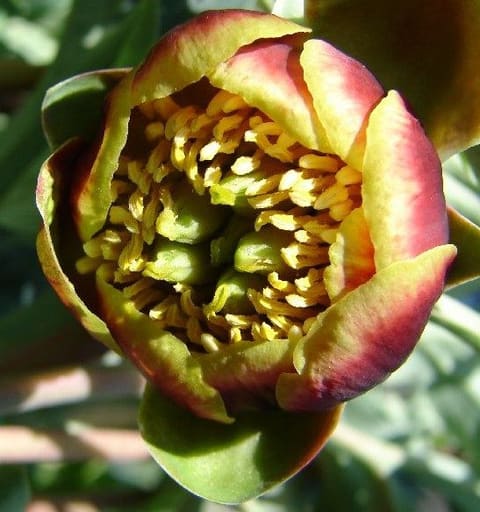
A nodding globe flower of red-edged yellow-green petals
FlowerCassondra SkinnerPublic domain

About the plant

What it is and where it grows — not part of any germination protocol.

The plant

Habit
perennialPlants of the World Online
Habit
Perennial, Forb/herbPLANTS Database
Height
1.5 ft45 cmPLANTS Database
Flower
RedPLANTS Database
Blooms
Mid SpringPLANTS Database
Native range
Native to the lower 48 statesPLANTS Database
Note
The only peony Deno found that germinates epigeally -- two large cotyledons rather than a hidden one.Seed Germination Theory and Practice, 2nd ed.

Growing conditions

Sun
Shade tolerance: MediumPLANTS Database
Soil
Adapted to medium textured soilsPLANTS Database
Soil pH
6.0-8.0PLANTS Database
Moisture
Moisture use: MediumPLANTS Database
Watering
Drought tolerance: MediumPLANTS Database

Toxicity is noted only where a source states it. No note here is not a finding of safety.

Sources: Plants of the World Online — Royal Botanic Gardens, Kew; PLANTS Database — USDA NRCS; Seed Germination Theory and Practice, 2nd ed. — N. C. Deno.

Worth knowing

  • Brown's peony is named after the Scottish botanist Robert Brown. Its fleshy roots store food that carries the plant through the dry summers of the western United States, ready to make new leaves and flowers the following spring. Wikipedia: Paeonia brownii

This source reports two treatments. Both are shown.

Protocol 1

DerivedN. C. Deno, 1993

Difficulty Low Rated by us, not by the source.

Start around March 1, 2027 for a May 3 last frost.

  1. Cold moist stratification

    Temperature: 40°F 4°C

    Six of six, in the fifth week. The radicle develops here.

  2. Warm moist stratification

    Temperature: 70°F 21°C

    The two large cotyledons open only after the shift to 70.

Germination happens during step 2, in 35 days.

100% germination in 35 days.

Every seed of six. The only peony Deno found that germinates epigeally.

This source doesn't state how long step 1 lasts.

Seed Germination Theory and Practice, 2nd ed. — N. C. Deno, 1993 · Ch. 20, PaeoneaPublic domain
Show the original text
Paeonea (Ranunculacèae). Nicking the seeds of P. officinalis and P. suffruticosa was reported to give some promotion to germination in the first edition, but this has not been confirmed in later and more extensive experiments. P:anomala, emodi, lutea, mlkosewetschii, obovata, and vernalis germ. at 70. similar to P.officinalis. Germination consists of forming a radicle and a branching root system. This requires about 2 m after which the seedlings are given 3 m at 40. On shifting back to 70 the true leaf forms (hypogeal). Germination was hypogeal in all but P. brownii,tand all germ. at 70 except P. broteri and P. brownii. These germ. at 40. Treatment with GA-3 gave a small increase in rate of germination in P. officinalis and P. suffruticosa. P. brownii germ. 40(6/6 in 5th w) and 70-40(2/6 in 3rd w). A radicle develops at 40, but the two large cotyledons do not develop until shifting to 70. T his was the only Paonea that germ. in an epigeal manner.
Seed Germination Theory and Practice, 2nd ed., Ch. 20, Paeonea. Quoted exactly. Every value on this card comes from this record, except the difficulty rating, which is ours; the step names come from a fixed list.

Protocol 2

DerivedN. C. Deno, 1993

Difficulty Moderate Rated by us, not by the source.

Start around December 15, 2026 for a May 3 last frost.

  1. Warm moist stratification

    Duration: 90 daysTemperature: 70°F 21°C

  2. Cold moist stratification

    Temperature: 40°F 4°C

    Two of six, in the third week.

  3. Warm moist stratification

    Temperature: 70°F 21°C

    The two large cotyledons open only after the shift to 70.

about 3 months from start to step 3. Germination happens during step 3, in 21 days.

33% germination in 21 days.

Starting warm costs two thirds of the packet. Sow it cold.

This source doesn't state how long step 2 lasts.

Seed Germination Theory and Practice, 2nd ed. — N. C. Deno, 1993 · Ch. 20, PaeoneaPublic domain
Show the original text
Paeonea (Ranunculacèae). Nicking the seeds of P. officinalis and P. suffruticosa was reported to give some promotion to germination in the first edition, but this has not been confirmed in later and more extensive experiments. P:anomala, emodi, lutea, mlkosewetschii, obovata, and vernalis germ. at 70. similar to P.officinalis. Germination consists of forming a radicle and a branching root system. This requires about 2 m after which the seedlings are given 3 m at 40. On shifting back to 70 the true leaf forms (hypogeal). Germination was hypogeal in all but P. brownii,tand all germ. at 70 except P. broteri and P. brownii. These germ. at 40. Treatment with GA-3 gave a small increase in rate of germination in P. officinalis and P. suffruticosa. P. brownii germ. 40(6/6 in 5th w) and 70-40(2/6 in 3rd w). A radicle develops at 40, but the two large cotyledons do not develop until shifting to 70. T his was the only Paonea that germ. in an epigeal manner.
Seed Germination Theory and Practice, 2nd ed., Ch. 20, Paeonea. Quoted exactly. Every value on this card comes from this record, except the difficulty rating, which is ours; the step names come from a fixed list.

Germination trials

Readers’ own records of sowing this species, published after review. Share your trial · All trials

Add to My Garden

View species page