Deno’s GardenMy Garden

Paeonia obovata

Chinese Peony · Woodland Peony

Family PaeoniaceaeGenus Paeonia

Also published as Paeonia vernalis. You are in the right place.

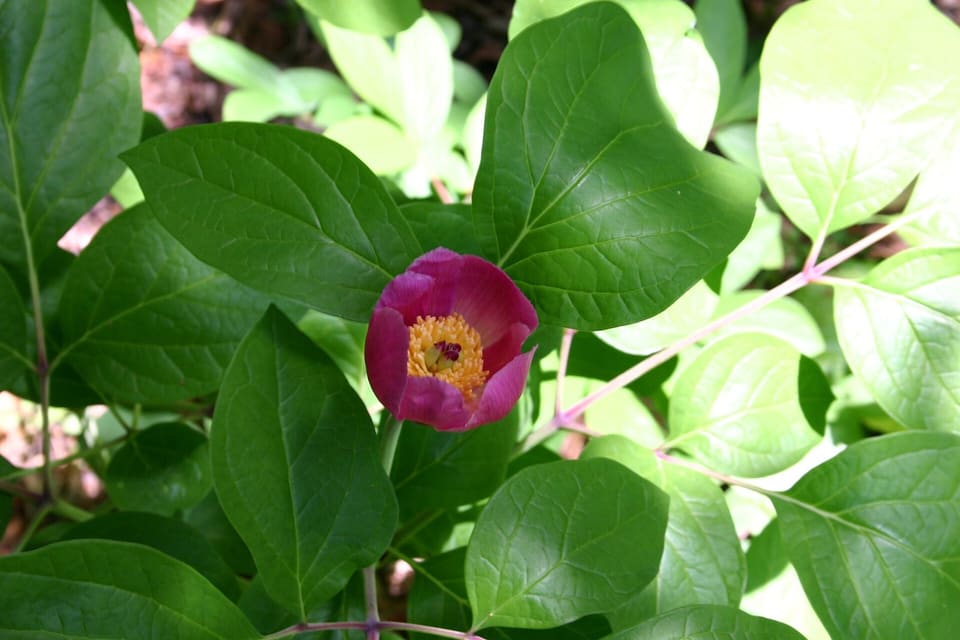
A deep red-pink cup with a yellow center among broad rounded leaves
FlowerUser:SB_JohnnyCC BY-SA 3.0

About the plant

What it is and where it grows — not part of any germination protocol.

The plant

Habit
Herbaceous perennialPlant Finder
Habit
perennialPlants of the World Online
Height
1-2 ft30-60 cmPlant Finder
Spread
1-2 ft30-60 cmPlant Finder
Flower
Showy, fragrant; white, red or purplePlant Finder
Blooms
MayPlant Finder
Native range
Eastern temperate AsiaPlant Finder
Hardiness zones
5-8Plant Finder
Note
Showy fruit. Tolerates rabbits and deer.Plant Finder

Growing conditions

Sun
Part shadePlant Finder
Soil
Rich, fertile, medium moisturePlant Finder
Watering
MediumPlant Finder

Toxicity is noted only where a source states it. No note here is not a finding of safety.

Sources: Plant Finder — Missouri Botanical Garden; Plants of the World Online — Royal Botanic Gardens, Kew.

Worth knowing

  • Sometimes called woodland peony, it grows wild in China, Korea, Japan, Far Eastern Russia and Sakhalin. Karl Maximovich first described it in 1859, from a specimen collected in the Amur region. Wikipedia: Paeonia obovata

This source reports three treatments. All are shown.

Protocol 1

DerivedN. C. Deno, 1993

Difficulty High Rated by us, not by the source.

Start around June 19, 2027 for a May 3 last frost. Too late for spring 2027 — that needed starting on June 18, 2026.

  1. Dry storage

    Deno says only "DS seed" -- no period and no temperature.

  2. Warm moist stratification

    Duration: 90 daysTemperature: 70°F 21°C

  3. Cold moist stratification

    Duration: 90 daysTemperature: 40°F 4°C

  4. Warm moist stratification

    Duration: 90 daysTemperature: 70°F 21°C

    One seed of three.

  5. Cold moist stratification

    Temperature: 40°F 4°C

    One more of three.

about 9 months from start to step 5. Germination happens during step 5; time not stated, 21 days assumed.

33% germination.

One seed of three, twice over, across four cycles. Deno reports this under P. vernalis, which is this same species.

This source doesn't state how long step 1 lasts.

Seed Germination Theory and Practice, 2nd ed. — N. C. Deno, 1993 · Ch. 20, PaeoneaPublic domain
Show the original text
Paeonea (Ranunculacèae). Nicking the seeds of P. officinalis and P. suffruticosa was reported to give some promotion to germination in the first edition, but this has not been confirmed in later and more extensive experiments. P:anomala, emodi, lutea, mlkosewetschii, obovata, and vernalis germ. at 70. similar to P.officinalis. Germination consists of forming a radicle and a branching root system. This requires about 2 m after which the seedlings are given 3 m at 40. On shifting back to 70 the true leaf forms (hypogeal). Germination was hypogeal in all but P. brownii,tand all germ. at 70 except P. broteri and P. brownii. These germ. at 40. Treatment with GA-3 gave a small increase in rate of germination in P. officinalis and P. suffruticosa. P. vernalis germ. 70-40-70(1/3)-40(1/3) and none in 40-70-40 using DS seed.
Seed Germination Theory and Practice, 2nd ed., Ch. 20, Paeonea. Quoted exactly. Every value on this card comes from this record, except the difficulty rating, which is ours; the step names come from a fixed list.

Protocol 2

DerivedN. C. Deno, 1993

Difficulty Moderate Rated by us, not by the source.

  1. Warm moist stratification

    Duration: 60 daysTemperature: 70°F 21°C

    The radicle and its branching root system form here. This is what Deno counts as germination.

  2. Cold moist stratification

    Duration: 90 daysTemperature: 40°F 4°C

  3. Warm moist stratification

    Temperature: 70°F 21°C

    The single true leaf forms only now. Germination is hypogeal.

about 5 months from start to step 3. Germination happens during step 3.

Deno lists it as germinating at 70 like P. officinalis, and gives no figures for it.

This source doesn't state how long step 3 lasts.

Seed Germination Theory and Practice, 2nd ed. — N. C. Deno, 1993 · Ch. 20, PaeoneaPublic domain
Show the original text
Paeonea (Ranunculacèae). Nicking the seeds of P. officinalis and P. suffruticosa was reported to give some promotion to germination in the first edition, but this has not been confirmed in later and more extensive experiments. P:anomala, emodi, lutea, mlkosewetschii, obovata, and vernalis germ. at 70. similar to P.officinalis. Germination consists of forming a radicle and a branching root system. This requires about 2 m after which the seedlings are given 3 m at 40. On shifting back to 70 the true leaf forms (hypogeal). Germination was hypogeal in all but P. brownii,tand all germ. at 70 except P. broteri and P. brownii. These germ. at 40. Treatment with GA-3 gave a small increase in rate of germination in P. officinalis and P. suffruticosa. P. vernalis germ. 70-40-70(1/3)-40(1/3) and none in 40-70-40 using DS seed.
Seed Germination Theory and Practice, 2nd ed., Ch. 20, Paeonea. Quoted exactly. Every value on this card comes from this record, except the difficulty rating, which is ours; the step names come from a fixed list.

Protocol 3

DerivedN. C. Deno, 1993
  1. Dry storage

    Deno says only "DS seed" -- no period and no temperature.

  2. Cold moist stratification

    Duration: 90 daysTemperature: 40°F 4°C

  3. Warm moist stratification

    Duration: 90 daysTemperature: 70°F 21°C

  4. Cold moist stratification

    Temperature: 40°F 4°C

    Nothing at all.

about 6 months from start to step 4. Germination happens during step 4.

0% germination.

Nothing over three cycles started cold. Deno reports this under P. vernalis, which is this same species.

This source doesn't state how long steps 1 and 4 last.
Seed Germination Theory and Practice, 2nd ed. — N. C. Deno, 1993 · Ch. 20, PaeoneaPublic domain
Show the original text
Paeonea (Ranunculacèae). Nicking the seeds of P. officinalis and P. suffruticosa was reported to give some promotion to germination in the first edition, but this has not been confirmed in later and more extensive experiments. P:anomala, emodi, lutea, mlkosewetschii, obovata, and vernalis germ. at 70. similar to P.officinalis. Germination consists of forming a radicle and a branching root system. This requires about 2 m after which the seedlings are given 3 m at 40. On shifting back to 70 the true leaf forms (hypogeal). Germination was hypogeal in all but P. brownii,tand all germ. at 70 except P. broteri and P. brownii. These germ. at 40. Treatment with GA-3 gave a small increase in rate of germination in P. officinalis and P. suffruticosa. P. vernalis germ. 70-40-70(1/3)-40(1/3) and none in 40-70-40 using DS seed.
Seed Germination Theory and Practice, 2nd ed., Ch. 20, Paeonea. Quoted exactly. Every value on this card comes from this record; the step names come from a fixed list.

Germination trials

Readers’ own records of sowing this species, published after review. Share your trial · All trials

Add to My Garden

View species page