Deno’s GardenMy Garden

Viola canina

Dog Violet · Heath Dog-violet · Heath Violet

Family ViolaceaeGenus Viola

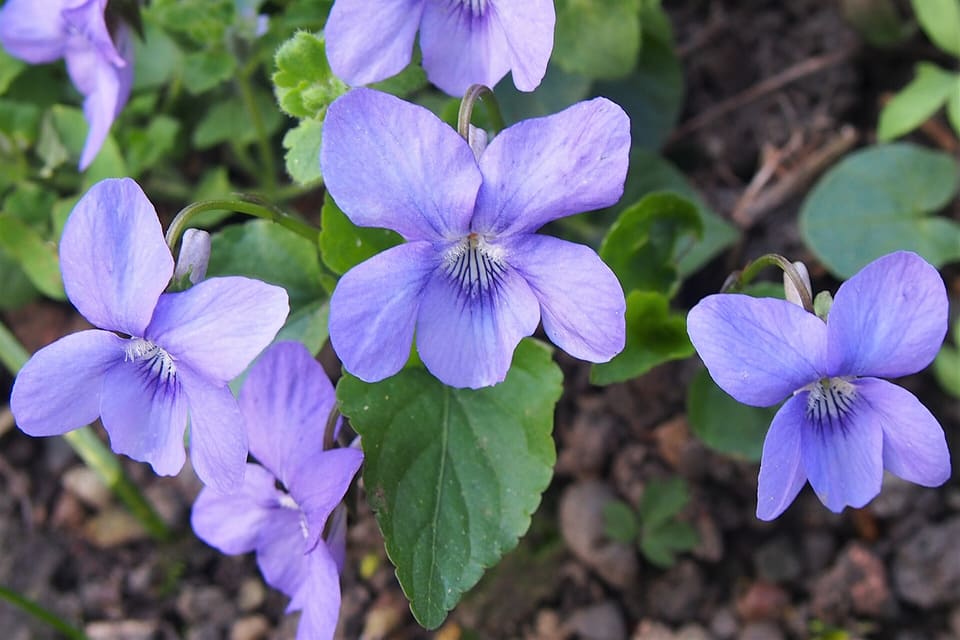
Violet-blue flowers with five rounded petals and pale throats streaked with dark lines, above heart-shaped leaves.
FlowerAgnieszka Kwiecień, NovaCC BY-SA 4.0

About the plant

What it is and where it grows — not part of any germination protocol.

Habit
perennialPlants of the World Online
Habit
Perennial, Forb/herbPLANTS Database
Flower
Blue-violet, gray-violetFlora of North America
Native range
Albania, Altay, Austria, Baltic States, Belarus, Belgium and elsewhereGBIF Backbone Taxonomy

Toxicity is noted only where a source states it. No note here is not a finding of safety.

Sources: Plants of the World Online — Royal Botanic Gardens, Kew; PLANTS Database — USDA NRCS; Flora of North America — Flora of North America Editorial Committee; GBIF Backbone Taxonomy — Global Biodiversity Information Facility.

This source reports 4 treatments. All are shown.

Protocol 1

DerivedN. C. Deno, 1996

Difficulty High Rated by us, not by the source.

Start around October 4, 2027 for a May 3 last frost. Too late for spring 2027 — that needed starting on October 3, 2026.

  1. Warm moist stratification

    Duration: 90 daysTemperature: 70°F 21°C Light: light

  2. Cold moist stratification

    Duration: 90 daysTemperature: 40°F 4°C

  3. Warm moist stratification

    Duration: 90 daysTemperature: 70°F 21°C Light: dark

about 6 months from start to step 3. Germination happens during step 3, in 4 days.

58% germination in 4 days.

Seed Germination Theory and Practice, 1st Supplement — N. C. Deno, 1996 · 1st Supplement, Viola p. 86Public domain
Show the original text
Viola (Violaceae). Four species of rosulate Violas from the Andes germ. only in 40 GA-3 (2nd Ed.). A most important new result is that all four samples germ. identically after fours years of DS. This shows that these have considerable longevity in DS in contrast to species native to Eastern U. V. canina germ. 70 GA-3(54% in 3-5 w), 70L-40-70D(58% on 4th d), and none in 70D, 40, or OT. Seeds DS 1 y were dead.
Seed Germination Theory and Practice, 1st Supplement, 1st Supplement, Viola p. 86. Quoted exactly. Every value on this card comes from this record, except the difficulty rating, which is ours; the step names come from a fixed list.

Protocol 2

DerivedN. C. Deno, 1996

Difficulty Moderate Rated by us, not by the source.

Start around March 1, 2027 for a May 3 last frost.

  1. Gibberellic acid soak

  2. Sow and cover

    Temperature: 70°F 21°C

No stated waiting before sowing. Then 35 days to germinate.

54% germination in 21–35 days.

Seed Germination Theory and Practice, 1st Supplement — N. C. Deno, 1996 · 1st Supplement, Viola p. 86Public domain
Show the original text
Viola (Violaceae). Four species of rosulate Violas from the Andes germ. only in 40 GA-3 (2nd Ed.). A most important new result is that all four samples germ. identically after fours years of DS. This shows that these have considerable longevity in DS in contrast to species native to Eastern U. V. canina germ. 70 GA-3(54% in 3-5 w), 70L-40-70D(58% on 4th d), and none in 70D, 40, or OT. Seeds DS 1 y were dead.
Seed Germination Theory and Practice, 1st Supplement, 1st Supplement, Viola p. 86. Quoted exactly. Every value on this card comes from this record, except the difficulty rating, which is ours; the step names come from a fixed list.

Protocol 3

DerivedN. C. Deno, 1996
  1. Sow and cover

    Temperature: 70°F 21°C Light: dark

No stated waiting before sowing.

0% germination.

Nothing germinated at 70.

Seed Germination Theory and Practice, 1st Supplement — N. C. Deno, 1996 · 1st Supplement, Viola p. 86Public domain
Show the original text
Viola (Violaceae). Four species of rosulate Violas from the Andes germ. only in 40 GA-3 (2nd Ed.). A most important new result is that all four samples germ. identically after fours years of DS. This shows that these have considerable longevity in DS in contrast to species native to Eastern U. V. canina germ. 70 GA-3(54% in 3-5 w), 70L-40-70D(58% on 4th d), and none in 70D, 40, or OT. Seeds DS 1 y were dead.
Seed Germination Theory and Practice, 1st Supplement, 1st Supplement, Viola p. 86. Quoted exactly. Every value on this card comes from this record; the step names come from a fixed list.

Protocol 4

DerivedN. C. Deno, 1996

Difficulty Very high Rated by us, not by the source.

  1. Sow outdoors and leave it

    Nothing germinated outdoors.

No stated waiting before sowing.

0% germination.

This source doesn't state how long step 1 lasts.

Seed Germination Theory and Practice, 1st Supplement — N. C. Deno, 1996 · 1st Supplement, Viola p. 86Public domain
Show the original text
Viola (Violaceae). Four species of rosulate Violas from the Andes germ. only in 40 GA-3 (2nd Ed.). A most important new result is that all four samples germ. identically after fours years of DS. This shows that these have considerable longevity in DS in contrast to species native to Eastern U. V. canina germ. 70 GA-3(54% in 3-5 w), 70L-40-70D(58% on 4th d), and none in 70D, 40, or OT. Seeds DS 1 y were dead.
Seed Germination Theory and Practice, 1st Supplement, 1st Supplement, Viola p. 86. Quoted exactly. Every value on this card comes from this record, except the difficulty rating, which is ours; the step names come from a fixed list.

Germination trials

Readers’ own records of sowing this species, published after review. Share your trial · All trials

Add to My Garden

View species page