Deno’s GardenMy Garden

Gahnia sieberiana

Red-fruit Saw-sedge

Family CyperaceaeGenus Gahnia

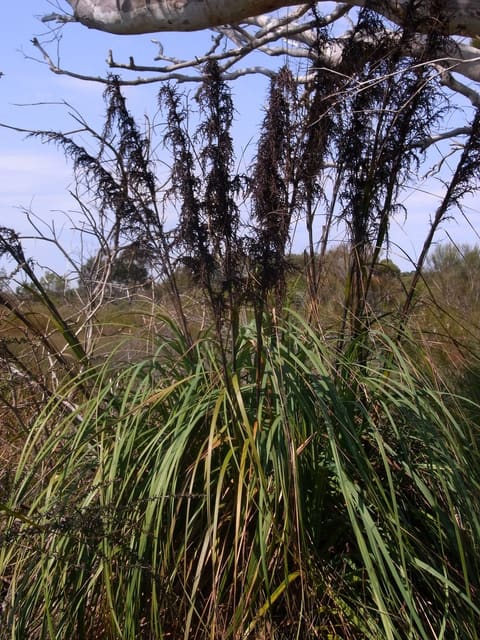
Tall dark drooping seed panicles rising from a broad clump of arching strap leaves, below a white gum branch
The whole plantPoyt448 Peter WoodardCC BY-SA 3.0

About the plant

What it is and where it grows — not part of any germination protocol.

Habit
perennialPlants of the World Online
Flower
BlackWikipedia

Toxicity is noted only where a source states it. No note here is not a finding of safety.

Sources: Plants of the World Online — Royal Botanic Gardens, Kew; Wikipedia — Wikipedia contributors.

Worth knowing

  • Red-fruit saw-sedge is named after the Bohemian collector Franz Wilhelm Sieber, one of many species that honor him. The German botanist Carl Sigismund Kunth described it in 1837. Many insect larvae have been recorded feeding on it. Wikipedia: Gahnia sieberiana

This source reports 4 treatments. All are shown.

Protocol 1

DerivedN. C. Deno, 1998

Difficulty Moderate Rated by us, not by the source.

Start around May 15, 2027 for a May 3 last frost. Too late for spring 2027 — that needed starting on May 14, 2026.

  1. Cold moist stratification

    Duration: 90 daysTemperature: 40°F 4°C

  2. Warm moist stratification

    Duration: 90 daysTemperature: 70°F 21°C Light: dark

  3. Cold moist stratification

    Duration: 90 daysTemperature: 40°F 4°C

  4. Warm moist stratification

    Duration: 90 daysTemperature: 70°F 21°C Light: light

  5. Cold moist stratification

    Duration: 90 daysTemperature: 40°F 4°C

  6. Warm moist stratification

    Duration: 90 daysTemperature: 70°F 21°C Light: light

    30 germinated in this phase.

Steps after step 4 run on after germination.

about 9 months from start to step 4. Germination happens during step 4, in 56 days.

70% germination in 21–56 days.

Seed Germination Theory and Practice, 2nd Supplement — N. C. Deno, 1998 · 2nd Supplement, Gahnia p. 35Public domain
Show the original text
Gahnia (Cyperaceae). Both species had an absolute light requirement. Both samples were kept in 70L for longer than the usual 3 m because germination was continuing. Any treatment prior to placing in 70L either had no effect or was deleterious. G. sieberiana germ. only in light. The data were 70L{59% in 5-18 w), 40- 70L(21% in 6-16 w)-40-70L(26% in 6th w), 40-70D-40-70L(70% in 3-8 w)-40- 70L(30% in 4th w), and 70D-40-70L(34% in 4-12 w)-40-70L(11% in 2nd w). None germ. in 70D-40-70D, 70 GA-3, OS, or 40-70D. When the sample in 70 GA-3 was shifted to 70L after 3 m, it germ. 71% in 3-11 w. Seeds DS 1 y germ. 70L(42% in 4-15 w) and 70D(none) showing little if any deterioration.
Seed Germination Theory and Practice, 2nd Supplement, 2nd Supplement, Gahnia p. 35. Quoted exactly. Every value on this card comes from this record, except the difficulty rating, which is ours; the step names come from a fixed list.

Protocol 2

DerivedN. C. Deno, 1998

Difficulty Moderate Rated by us, not by the source.

Start around December 22, 2026 for a May 3 last frost. Too late for spring 2027 — that needed starting on December 21, 2025.

  1. Dry storage

    Duration: 365 daysTemperature: 70°F 21°C

  2. Sow and cover

    Temperature: 70°F 21°C Light: light

about 12 months from start to sowing. Then 105 days to germinate.

42% germination in 28–105 days.

Seed Germination Theory and Practice, 2nd Supplement — N. C. Deno, 1998 · 2nd Supplement, Gahnia p. 35Public domain
Show the original text
Gahnia (Cyperaceae). Both species had an absolute light requirement. Both samples were kept in 70L for longer than the usual 3 m because germination was continuing. Any treatment prior to placing in 70L either had no effect or was deleterious. G. sieberiana germ. only in light. The data were 70L{59% in 5-18 w), 40- 70L(21% in 6-16 w)-40-70L(26% in 6th w), 40-70D-40-70L(70% in 3-8 w)-40- 70L(30% in 4th w), and 70D-40-70L(34% in 4-12 w)-40-70L(11% in 2nd w). None germ. in 70D-40-70D, 70 GA-3, OS, or 40-70D. When the sample in 70 GA-3 was shifted to 70L after 3 m, it germ. 71% in 3-11 w. Seeds DS 1 y germ. 70L(42% in 4-15 w) and 70D(none) showing little if any deterioration.
Seed Germination Theory and Practice, 2nd Supplement, 2nd Supplement, Gahnia p. 35. Quoted exactly. Every value on this card comes from this record, except the difficulty rating, which is ours; the step names come from a fixed list.

Protocol 3

DerivedN. C. Deno, 1998

Difficulty High Rated by us, not by the source.

Start around July 16, 2027 for a May 3 last frost. Too late for spring 2027 — that needed starting on July 15, 2026.

  1. Warm moist stratification

    Duration: 90 daysTemperature: 70°F 21°C Light: dark

  2. Cold moist stratification

    Duration: 90 daysTemperature: 40°F 4°C

  3. Warm moist stratification

    Duration: 90 daysTemperature: 70°F 21°C Light: light

  4. Cold moist stratification

    Duration: 90 daysTemperature: 40°F 4°C

  5. Warm moist stratification

    Duration: 90 daysTemperature: 70°F 21°C Light: light

    11 germinated in this phase.

Steps after step 3 run on after germination.

about 6 months from start to step 3. Germination happens during step 3, in 84 days.

34% germination in 28–84 days.

Seed Germination Theory and Practice, 2nd Supplement — N. C. Deno, 1998 · 2nd Supplement, Gahnia p. 35Public domain
Show the original text
Gahnia (Cyperaceae). Both species had an absolute light requirement. Both samples were kept in 70L for longer than the usual 3 m because germination was continuing. Any treatment prior to placing in 70L either had no effect or was deleterious. G. sieberiana germ. only in light. The data were 70L{59% in 5-18 w), 40- 70L(21% in 6-16 w)-40-70L(26% in 6th w), 40-70D-40-70L(70% in 3-8 w)-40- 70L(30% in 4th w), and 70D-40-70L(34% in 4-12 w)-40-70L(11% in 2nd w). None germ. in 70D-40-70D, 70 GA-3, OS, or 40-70D. When the sample in 70 GA-3 was shifted to 70L after 3 m, it germ. 71% in 3-11 w. Seeds DS 1 y germ. 70L(42% in 4-15 w) and 70D(none) showing little if any deterioration.
Seed Germination Theory and Practice, 2nd Supplement, 2nd Supplement, Gahnia p. 35. Quoted exactly. Every value on this card comes from this record, except the difficulty rating, which is ours; the step names come from a fixed list.

Protocol 4

DerivedN. C. Deno, 1998

Difficulty High Rated by us, not by the source.

Start around May 29, 2027 for a May 3 last frost. Too late for spring 2027 — that needed starting on May 28, 2026.

  1. Cold moist stratification

    Duration: 90 daysTemperature: 40°F 4°C

  2. Warm moist stratification

    Duration: 90 daysTemperature: 70°F 21°C Light: light

    21 germinated in this phase.

  3. Cold moist stratification

    Duration: 90 daysTemperature: 40°F 4°C

  4. Warm moist stratification

    Duration: 90 daysTemperature: 70°F 21°C Light: light

about 9 months from start to step 4. Germination happens during step 4, in 42 days.
26% germination in 42 days.

Seed Germination Theory and Practice, 2nd Supplement — N. C. Deno, 1998 · 2nd Supplement, Gahnia p. 35Public domain
Show the original text
Gahnia (Cyperaceae). Both species had an absolute light requirement. Both samples were kept in 70L for longer than the usual 3 m because germination was continuing. Any treatment prior to placing in 70L either had no effect or was deleterious. G. sieberiana germ. only in light. The data were 70L{59% in 5-18 w), 40- 70L(21% in 6-16 w)-40-70L(26% in 6th w), 40-70D-40-70L(70% in 3-8 w)-40- 70L(30% in 4th w), and 70D-40-70L(34% in 4-12 w)-40-70L(11% in 2nd w). None germ. in 70D-40-70D, 70 GA-3, OS, or 40-70D. When the sample in 70 GA-3 was shifted to 70L after 3 m, it germ. 71% in 3-11 w. Seeds DS 1 y germ. 70L(42% in 4-15 w) and 70D(none) showing little if any deterioration.
Seed Germination Theory and Practice, 2nd Supplement, 2nd Supplement, Gahnia p. 35. Quoted exactly. Every value on this card comes from this record, except the difficulty rating, which is ours; the step names come from a fixed list.

Germination trials

Readers’ own records of sowing this species, published after review. Share your trial · All trials

Add to My Garden

View species page