Deno’s GardenMy Garden

Pyrus calleryana

Bradford · Bradford Pear · Callery Pear

Family RosaceaeGenus Pyrus

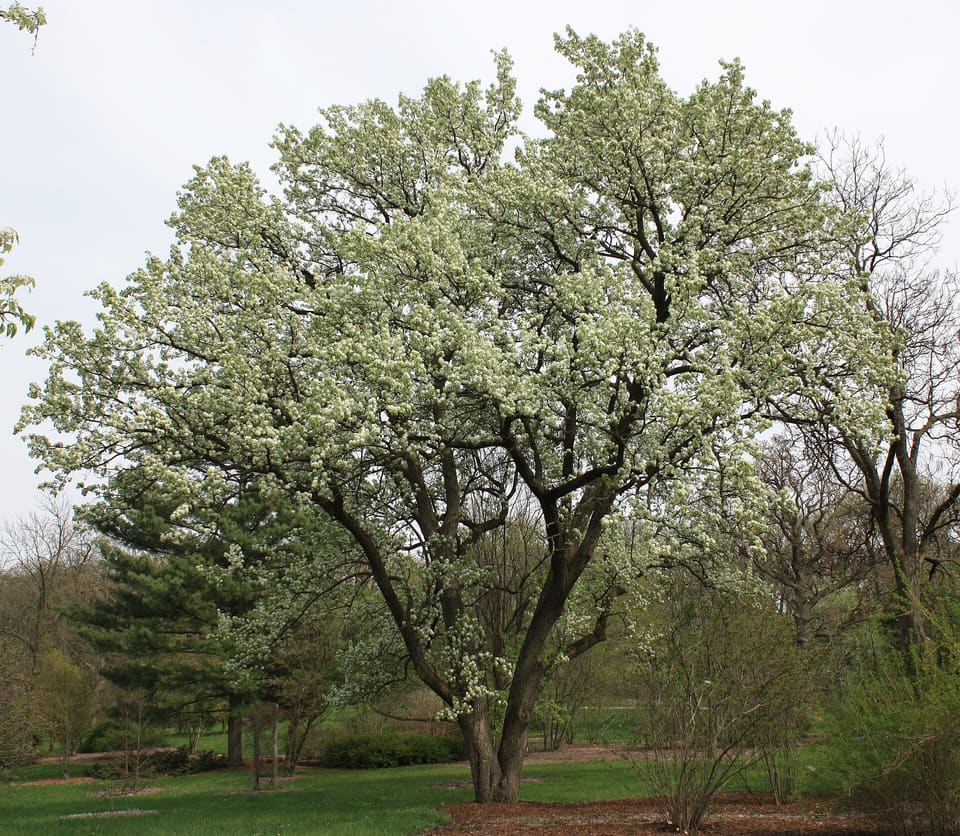
A broad tree smothered in small white blossom on upswept branches, standing on mown grass before bare trees.
The whole plantBruce MarlinCC BY 3.0

About the plant

What it is and where it grows — not part of any germination protocol.

The plant

Habit
treePlants of the World Online
Habit
Perennial, TreePLANTS Database
Height
30-50 ft9-15 mExtension Gardener Plant Toolbox
Spread
20-35 ft6-11 mExtension Gardener Plant Toolbox
Flower
Cream/Tan, WhiteExtension Gardener Plant Toolbox
Blooms
SpringExtension Gardener Plant Toolbox
Native range
China North-Central, China South-Central, China Southeast, Japan, Korea, Taiwan and elsewhereGBIF Backbone Taxonomy
Hardiness zones
5-9Extension Gardener Plant Toolbox

Growing conditions

Sun
Full sun; Partial ShadeExtension Gardener Plant Toolbox
Soil
Clay, Loam (Silt), SandExtension Gardener Plant Toolbox
Soil pH
Acid (<6.0), Alkaline (>8.0), Neutral (6.0-8.0)Extension Gardener Plant Toolbox
Moisture
Good Drainage, Moist, Occasionally DryExtension Gardener Plant Toolbox
Watering
Drought tolerance: LowPLANTS Database

Toxicity is noted only where a source states it. No note here is not a finding of safety.

Sources: Plants of the World Online — Royal Botanic Gardens, Kew; PLANTS Database — USDA NRCS; Extension Gardener Plant Toolbox — NC State Extension; GBIF Backbone Taxonomy — Global Biodiversity Information Facility.

Worth knowing

  • Named for the missionary Joseph-Marie Callery, who sent specimens from China to Europe. Its cultivar Bradford pear, said to smell like rotting fish, is widely planted in the US and increasingly regarded as invasive. Wikipedia: Pyrus calleryana

Three sources report 13 treatments between them. All are shown.

Protocol 1

DerivedN. C. Deno, 1998

Difficulty Low Rated by us, not by the source.

Start around July 21, 2027 for a May 3 last frost. Too late for spring 2027 — that needed starting on July 20, 2025.

  1. Clean the flesh off the seed

  2. Leach in running water

    Duration: 7 days

    Washed and cleaned daily for 7 days.

  3. Dry storage

    Duration: 540 daysTemperature: 70°F 21°C

  4. Cold moist stratification

    Temperature: 40°F 4°C

about 1.5 years from start to step 4. Germination happens during step 4, in 77 days.

88% germination in 28–77 days.

Seed Germination Theory and Practice, 2nd Supplement — N. C. Deno, 1998 · 2nd Supplement, Pyrus p. 57Public domain
Show the original text
Pyrus (Rosaceae). P. calleryana DS 1 y germ. 40(88% in 4-10 w) and 70D-40(75% in 8th w)- 70D(25% on 3rd d). Seeds DS 2 y germ. 40(88% in 4-11 w) and 70D(35% in 2-8 w).
Seed Germination Theory and Practice, 2nd Supplement, 2nd Supplement, Pyrus p. 57. Quoted exactly. Every value on this card comes from this record, except the difficulty rating, which is ours; the step names come from a fixed list.

Protocol 2

DerivedN. C. Deno, 1998

Difficulty Low Rated by us, not by the source.

Start around January 26, 2027 for a May 3 last frost. Too late for spring 2027 — that needed starting on January 25, 2026.

  1. Dry storage

    Duration: 365 daysTemperature: 70°F 21°C

  2. Cold moist stratification

    Temperature: 40°F 4°C

about 12 months from start to step 2. Germination happens during step 2, in 70 days.

88% germination in 28–70 days.

Seed Germination Theory and Practice, 2nd Supplement — N. C. Deno, 1998 · 2nd Supplement, Pyrus p. 57Public domain
Show the original text
Pyrus (Rosaceae). P. calleryana DS 1 y germ. 40(88% in 4-10 w) and 70D-40(75% in 8th w)- 70D(25% on 3rd d). Seeds DS 2 y germ. 40(88% in 4-11 w) and 70D(35% in 2-8 w).
Seed Germination Theory and Practice, 2nd Supplement, 2nd Supplement, Pyrus p. 57. Quoted exactly. Every value on this card comes from this record, except the difficulty rating, which is ours; the step names come from a fixed list.

Protocol 3

DerivedN. C. Deno, 1998

Difficulty Low Rated by us, not by the source.

Start around January 19, 2027 for a May 3 last frost. Too late for spring 2027 — that needed starting on January 18, 2025.

  1. Dry storage

    Duration: 730 daysTemperature: 70°F 21°C

  2. Cold moist stratification

    Temperature: 40°F 4°C

about 2 years from start to step 2. Germination happens during step 2, in 77 days.

88% germination in 28–77 days.

Seed Germination Theory and Practice, 2nd Supplement — N. C. Deno, 1998 · 2nd Supplement, Pyrus p. 57Public domain
Show the original text
Pyrus (Rosaceae). P. calleryana DS 1 y germ. 40(88% in 4-10 w) and 70D-40(75% in 8th w)- 70D(25% on 3rd d). Seeds DS 2 y germ. 40(88% in 4-11 w) and 70D(35% in 2-8 w).
Seed Germination Theory and Practice, 2nd Supplement, 2nd Supplement, Pyrus p. 57. Quoted exactly. Every value on this card comes from this record, except the difficulty rating, which is ours; the step names come from a fixed list.

Protocol 4

DerivedN. C. Deno, 1998

Difficulty Moderate Rated by us, not by the source.

Start around November 3, 2026 for a May 3 last frost.

  1. Clean the flesh off the seed

  2. Leach in running water

    Duration: 7 days

    Washed and cleaned daily for 7 days.

  3. Warm moist stratification

    Duration: 90 daysTemperature: 70°F 21°C

    3 germinated in this phase.

  4. Cold moist stratification

    Duration: 90 daysTemperature: 40°F 4°C

about 3 months from start to step 4. Germination happens during step 4, in 56 days.

75% germination in 56 days.

Seed Germination Theory and Practice, 2nd Supplement — N. C. Deno, 1998 · 2nd Supplement, Pyrus p. 57Public domain
Show the original text
Pyrus (Rosaceae). P. calleryana DS 1 y germ. 40(88% in 4-10 w) and 70D-40(75% in 8th w)- 70D(25% on 3rd d). Seeds DS 2 y germ. 40(88% in 4-11 w) and 70D(35% in 2-8 w).
Seed Germination Theory and Practice, 2nd Supplement, 2nd Supplement, Pyrus p. 57. Quoted exactly. Every value on this card comes from this record, except the difficulty rating, which is ours; the step names come from a fixed list.

Protocol 5

DerivedN. C. Deno, 1998

Difficulty Moderate Rated by us, not by the source.

Start around November 11, 2026 for a May 3 last frost. Too late for spring 2027 — that needed starting on November 10, 2025.

  1. Dry storage

    Duration: 365 daysTemperature: 70°F 21°C

  2. Warm moist stratification

    Duration: 90 daysTemperature: 70°F 21°C Light: dark

  3. Cold moist stratification

    Duration: 90 daysTemperature: 40°F 4°C

  4. Warm moist stratification

    Duration: 90 daysTemperature: 70°F 21°C Light: dark

    25 germinated in this phase.

Steps after step 3 run on after germination.

about 15 months from start to step 3. Germination happens during step 3, in 56 days.

75% germination in 56 days.

Seed Germination Theory and Practice, 2nd Supplement — N. C. Deno, 1998 · 2nd Supplement, Pyrus p. 57Public domain
Show the original text
Pyrus (Rosaceae). P. calleryana DS 1 y germ. 40(88% in 4-10 w) and 70D-40(75% in 8th w)- 70D(25% on 3rd d). Seeds DS 2 y germ. 40(88% in 4-11 w) and 70D(35% in 2-8 w).
Seed Germination Theory and Practice, 2nd Supplement, 2nd Supplement, Pyrus p. 57. Quoted exactly. Every value on this card comes from this record, except the difficulty rating, which is ours; the step names come from a fixed list.

Protocol 6

DerivedN. C. Deno, 1998

Difficulty Moderate Rated by us, not by the source.

Start around February 9, 2027 for a May 3 last frost. Too late for spring 2027 — that needed starting on February 8, 2025.

  1. Dry storage

    Duration: 730 daysTemperature: 70°F 21°C

  2. Sow and cover

    Temperature: 70°F 21°C Light: dark

about 2 years from start to sowing. Then 56 days to germinate.

35% germination in 14–56 days.

Seed Germination Theory and Practice, 2nd Supplement — N. C. Deno, 1998 · 2nd Supplement, Pyrus p. 57Public domain
Show the original text
Pyrus (Rosaceae). P. calleryana DS 1 y germ. 40(88% in 4-10 w) and 70D-40(75% in 8th w)- 70D(25% on 3rd d). Seeds DS 2 y germ. 40(88% in 4-11 w) and 70D(35% in 2-8 w).
Seed Germination Theory and Practice, 2nd Supplement, 2nd Supplement, Pyrus p. 57. Quoted exactly. Every value on this card comes from this record, except the difficulty rating, which is ours; the step names come from a fixed list.

Protocol 7

DerivedN. C. Deno, 1996

Difficulty Low Rated by us, not by the source.

Start around January 11, 2027 for a May 3 last frost.

  1. Cold moist stratification

    Temperature: 40°F 4°C

Germination happens during step 1, in 84 days.

100% germination in 49–84 days.

Seed Germination Theory and Practice, 1st Supplement — N. C. Deno, 1996 · 1st Supplement, Pyrus p. 69Public domain
Show the original text
Pyrus (Rosaceae). P. "Buerre Bosc" germ. 70D(40% in 2-4 d)-40(10%)-70-40-70D(30% on 3rd d) and 40(100% in 4th w). Placing the seeds initially at 40 is best, and It is interesting that an initial 3 m at 70 causes germination to extend over a number of cycles. P. calleriana seeds;coliected in October and WC 7 d germ. 40(100% in 7-12 w) and 70(3%)-40(74% in 8-12 w) (2nd Ed.). This declines to 95% after 6 m DS and 73% after 18 m DS. A sample coliected in mid-December a year later germ. 70D(95% in 3-7 d) and 40(95% in 5-7 w). The interpretation is that the blocking mechanism is destroyed by allowing the fruit to experience the cold of Nov. and Dec. P. "Kieffer" germ. 40(50% in 2-8 w)-70(50% in 3-9 d) and 70D(10%). &
Seed Germination Theory and Practice, 1st Supplement, 1st Supplement, Pyrus p. 69. Quoted exactly. Every value on this card comes from this record, except the difficulty rating, which is ours; the step names come from a fixed list.

Protocol 8

DerivedN. C. Deno, 1996

Difficulty Low Rated by us, not by the source.

Start around February 8, 2027 for a May 3 last frost.

  1. Clean the flesh off the seed

  2. Leach in running water

    Duration: 7 days

    Washed and cleaned daily for 7 days.

  3. Cold moist stratification

    Temperature: 40°F 4°C

7 days from start to step 3. Germination happens during step 3, in 49 days.

95% germination in 35–49 days.

Seed Germination Theory and Practice, 1st Supplement — N. C. Deno, 1996 · 1st Supplement, Pyrus p. 69Public domain
Show the original text
Pyrus (Rosaceae). P. "Buerre Bosc" germ. 70D(40% in 2-4 d)-40(10%)-70-40-70D(30% on 3rd d) and 40(100% in 4th w). Placing the seeds initially at 40 is best, and It is interesting that an initial 3 m at 70 causes germination to extend over a number of cycles. P. calleriana seeds;coliected in October and WC 7 d germ. 40(100% in 7-12 w) and 70(3%)-40(74% in 8-12 w) (2nd Ed.). This declines to 95% after 6 m DS and 73% after 18 m DS. A sample coliected in mid-December a year later germ. 70D(95% in 3-7 d) and 40(95% in 5-7 w). The interpretation is that the blocking mechanism is destroyed by allowing the fruit to experience the cold of Nov. and Dec. P. "Kieffer" germ. 40(50% in 2-8 w)-70(50% in 3-9 d) and 70D(10%). &
Seed Germination Theory and Practice, 1st Supplement, 1st Supplement, Pyrus p. 69. Quoted exactly. Every value on this card comes from this record, except the difficulty rating, which is ours; the step names come from a fixed list.

Protocol 9

DerivedN. C. Deno, 1996

Difficulty Low Rated by us, not by the source.

Start around September 29, 2027 for a May 3 last frost. Too late for spring 2027 — that needed starting on September 28, 2025.

  1. Clean the flesh off the seed

  2. Leach in running water

    Duration: 7 days

    Washed and cleaned daily for 7 days.

  3. Dry storage

    Duration: 540 daysTemperature: 70°F 21°C

  4. Sow and cover

    Temperature: 70°F 21°C Light: dark

about 1.5 years from start to sowing. Then 7 days to germinate.

95% germination in 3–7 days.

Seed Germination Theory and Practice, 1st Supplement — N. C. Deno, 1996 · 1st Supplement, Pyrus p. 69Public domain
Show the original text
Pyrus (Rosaceae). P. "Buerre Bosc" germ. 70D(40% in 2-4 d)-40(10%)-70-40-70D(30% on 3rd d) and 40(100% in 4th w). Placing the seeds initially at 40 is best, and It is interesting that an initial 3 m at 70 causes germination to extend over a number of cycles. P. calleriana seeds;coliected in October and WC 7 d germ. 40(100% in 7-12 w) and 70(3%)-40(74% in 8-12 w) (2nd Ed.). This declines to 95% after 6 m DS and 73% after 18 m DS. A sample coliected in mid-December a year later germ. 70D(95% in 3-7 d) and 40(95% in 5-7 w). The interpretation is that the blocking mechanism is destroyed by allowing the fruit to experience the cold of Nov. and Dec. P. "Kieffer" germ. 40(50% in 2-8 w)-70(50% in 3-9 d) and 70D(10%). &
Seed Germination Theory and Practice, 1st Supplement, 1st Supplement, Pyrus p. 69. Quoted exactly. Every value on this card comes from this record, except the difficulty rating, which is ours; the step names come from a fixed list.

Protocol 10

DerivedN. C. Deno, 1996

Difficulty Moderate Rated by us, not by the source.

Start around October 14, 2027 for a May 3 last frost. Too late for spring 2027 — that needed starting on October 13, 2026.

  1. Warm moist stratification

    Duration: 90 daysTemperature: 70°F 21°C

    3 germinated in this phase.

  2. Cold moist stratification

    Duration: 90 daysTemperature: 40°F 4°C

about 3 months from start to step 2. Germination happens during step 2, in 84 days.

74% germination in 56–84 days.

Seed Germination Theory and Practice, 1st Supplement — N. C. Deno, 1996 · 1st Supplement, Pyrus p. 69Public domain
Show the original text
Pyrus (Rosaceae). P. "Buerre Bosc" germ. 70D(40% in 2-4 d)-40(10%)-70-40-70D(30% on 3rd d) and 40(100% in 4th w). Placing the seeds initially at 40 is best, and It is interesting that an initial 3 m at 70 causes germination to extend over a number of cycles. P. calleriana seeds;coliected in October and WC 7 d germ. 40(100% in 7-12 w) and 70(3%)-40(74% in 8-12 w) (2nd Ed.). This declines to 95% after 6 m DS and 73% after 18 m DS. A sample coliected in mid-December a year later germ. 70D(95% in 3-7 d) and 40(95% in 5-7 w). The interpretation is that the blocking mechanism is destroyed by allowing the fruit to experience the cold of Nov. and Dec. P. "Kieffer" germ. 40(50% in 2-8 w)-70(50% in 3-9 d) and 70D(10%). &
Seed Germination Theory and Practice, 1st Supplement, 1st Supplement, Pyrus p. 69. Quoted exactly. Every value on this card comes from this record, except the difficulty rating, which is ours; the step names come from a fixed list.

Protocol 11

DerivedN. C. Deno, 1996

Difficulty Moderate Rated by us, not by the source.

Start around February 1, 2027 for a May 3 last frost.

  1. Clean the flesh off the seed

  2. Leach in running water

    Duration: 7 days

    Washed and cleaned daily for 7 days.

  3. Cold moist stratification

    Duration: 90 daysTemperature: 40°F 4°C

  4. Warm moist stratification

    Duration: 90 daysTemperature: 70°F 21°C

    50 germinated in this phase.

Steps after step 3 run on after germination.

7 days from start to step 3. Germination happens during step 3, in 56 days.

50% germination in 14–56 days.

Seed Germination Theory and Practice, 1st Supplement — N. C. Deno, 1996 · 1st Supplement, Pyrus p. 69Public domain
Show the original text
Pyrus (Rosaceae). P. "Buerre Bosc" germ. 70D(40% in 2-4 d)-40(10%)-70-40-70D(30% on 3rd d) and 40(100% in 4th w). Placing the seeds initially at 40 is best, and It is interesting that an initial 3 m at 70 causes germination to extend over a number of cycles. P. calleriana seeds;coliected in October and WC 7 d germ. 40(100% in 7-12 w) and 70(3%)-40(74% in 8-12 w) (2nd Ed.). This declines to 95% after 6 m DS and 73% after 18 m DS. A sample coliected in mid-December a year later germ. 70D(95% in 3-7 d) and 40(95% in 5-7 w). The interpretation is that the blocking mechanism is destroyed by allowing the fruit to experience the cold of Nov. and Dec. P. "Kieffer" germ. 40(50% in 2-8 w)-70(50% in 3-9 d) and 70D(10%). &
Seed Germination Theory and Practice, 1st Supplement, 1st Supplement, Pyrus p. 69. Quoted exactly. Every value on this card comes from this record, except the difficulty rating, which is ours; the step names come from a fixed list.

Protocol 12

DerivedN. C. Deno, 1996

Difficulty High Rated by us, not by the source.

Start around March 8, 2027 for a May 3 last frost.

  1. Clean the flesh off the seed

  2. Leach in running water

    Duration: 7 days

    Washed and cleaned daily for 7 days.

  3. Sow and cover

    Temperature: 70°F 21°C Light: dark

7 days from start to sowing. Germination time not stated; 21 days assumed.
10% germination.

Seed Germination Theory and Practice, 1st Supplement — N. C. Deno, 1996 · 1st Supplement, Pyrus p. 69Public domain
Show the original text
Pyrus (Rosaceae). P. "Buerre Bosc" germ. 70D(40% in 2-4 d)-40(10%)-70-40-70D(30% on 3rd d) and 40(100% in 4th w). Placing the seeds initially at 40 is best, and It is interesting that an initial 3 m at 70 causes germination to extend over a number of cycles. P. calleriana seeds;coliected in October and WC 7 d germ. 40(100% in 7-12 w) and 70(3%)-40(74% in 8-12 w) (2nd Ed.). This declines to 95% after 6 m DS and 73% after 18 m DS. A sample coliected in mid-December a year later germ. 70D(95% in 3-7 d) and 40(95% in 5-7 w). The interpretation is that the blocking mechanism is destroyed by allowing the fruit to experience the cold of Nov. and Dec. P. "Kieffer" germ. 40(50% in 2-8 w)-70(50% in 3-9 d) and 70D(10%). &
Seed Germination Theory and Practice, 1st Supplement, 1st Supplement, Pyrus p. 69. Quoted exactly. Every value on this card comes from this record, except the difficulty rating, which is ours; the step names come from a fixed list.

Protocol 13

DerivedN. C. Deno, 1993

Difficulty Low Rated by us, not by the source.

  1. Sow outdoors and leave it

    Up in March.

No stated waiting before sowing.

78% germination.

This source doesn't state how long step 1 lasts.

Seed Germination Theory and Practice, 2nd ed. — N. C. Deno, 1993 · Ch. 20, Pyrus p. 202Public domain
Show the original text
Pyrus (Rosaceae). P. calleryana germ.. 40(100% in 7-12 w) and less in 70(3%)-40(74% in 8-12 w) and outdoor treatment (78% in March) using either fresh seed or seed DS 6 m at 70:
Seed Germination Theory and Practice, 2nd ed., Ch. 20, Pyrus p. 202. Quoted exactly. Every value on this card comes from this record, except the difficulty rating, which is ours; the step names come from a fixed list.

Germination trials

Readers’ own records of sowing this species, published after review. Share your trial · All trials

Add to My Garden

View species page