Deno’s GardenMy Garden

Rosa palustris

Swamp Rose · Marsh Rose

Family RosaceaeGenus Rosa

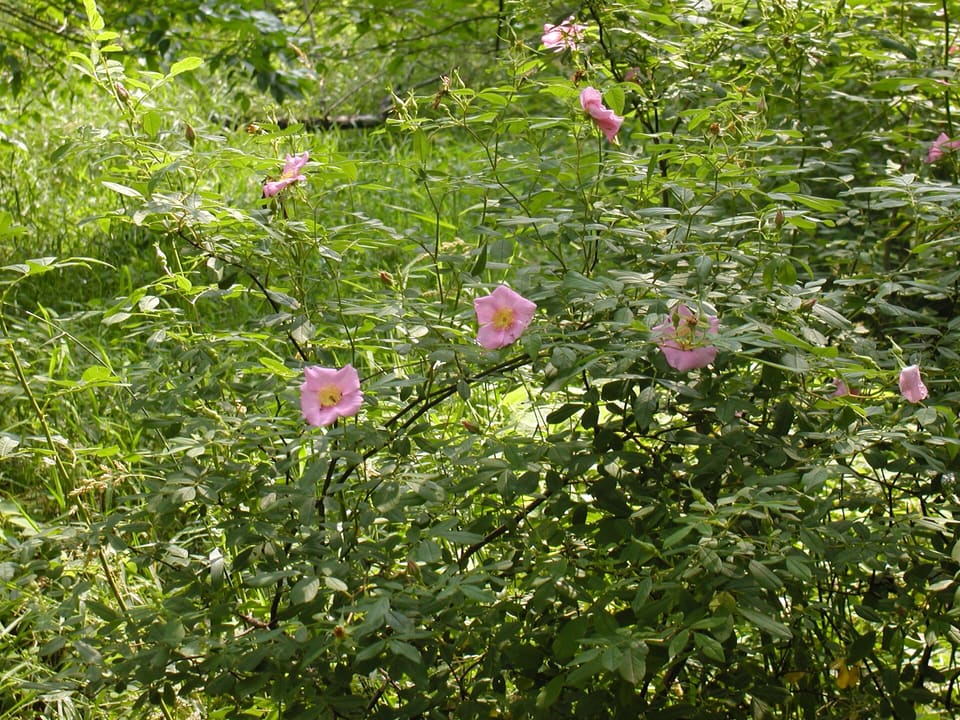
A loose thicket of thin arching canes with pale pink single roses scattered through it, at the edge of a sunlit meadow.
The whole plantUser:SB_JohnnyCC BY-SA 3.0

About the plant

What it is and where it grows — not part of any germination protocol.

The plant

Habit
ShrubExtension Gardener Plant Toolbox
Habit
shrubPlants of the World Online
Height
3-6 ft0.9-1.8 mExtension Gardener Plant Toolbox
Spread
3-6 ft0.9-1.8 mExtension Gardener Plant Toolbox
Flower
PinkExtension Gardener Plant Toolbox
Blooms
SummerExtension Gardener Plant Toolbox
Native range
Canada, lower 48 statesPLANTS Database
Hardiness zones
4-9Extension Gardener Plant Toolbox

Growing conditions

Sun
Full sun; Partial ShadeExtension Gardener Plant Toolbox
Soil
High Organic MatterExtension Gardener Plant Toolbox
Soil pH
Acid (<6.0)Extension Gardener Plant Toolbox
Moisture
Good Drainage, Moist, Occasionally WetExtension Gardener Plant Toolbox
Watering
Drought tolerance: LowPLANTS Database

Toxicity is noted only where a source states it. No note here is not a finding of safety.

Sources: Extension Gardener Plant Toolbox — NC State Extension; Plants of the World Online — Royal Botanic Gardens, Kew; PLANTS Database — USDA NRCS.

Worth knowing

  • Palustris is Latin for "of the marsh", where the swamp rose usually grows. It is a host plant of the blinded sphinx moth. Wikipedia: Rosa palustris

Two sources report 4 treatments between them. All are shown.

Protocol 1

DerivedN. C. Deno, 1998

Difficulty High Rated by us, not by the source.

Start around September 17, 2027 for a May 3 last frost. Too late for spring 2027 — that needed starting on September 16, 2024.

  1. Dry storage

    Duration: 730 daysTemperature: 70°F 21°C

  2. Warm moist stratification

    Duration: 90 daysTemperature: 70°F 21°C Light: dark

  3. Cold moist stratification

    Duration: 90 daysTemperature: 40°F 4°C

  4. Warm moist stratification

    Duration: 90 daysTemperature: 70°F 21°C Light: dark

about 2.5 years from start to step 4. Germination happens during step 4; time not stated, 21 days assumed.

60% germination.

Seed Germination Theory and Practice, 2nd Supplement — N. C. Deno, 1998 · 2nd Supplement, Rosa p. 58Public domain
Show the original text
Rosa (Rosaceae). Germinations are characterized by two features. First is that germinations begin after several cycles and continue over several years. Second is that light or GA-3 have no effect. Germination may occur in either 70D or 40, but when germination occurs at 70 it-is usually within a few days after the shift to 70. R. palustris DS 2 y germ. the same 70D-40-70D(60%) showing no deaths.
Seed Germination Theory and Practice, 2nd Supplement, 2nd Supplement, Rosa p. 58. Quoted exactly. Every value on this card comes from this record, except the difficulty rating, which is ours; the step names come from a fixed list.

Protocol 2

DerivedN. C. Deno, 1996

Difficulty High Rated by us, not by the source.

Start around January 1, 2027 for a May 3 last frost.

  1. Cold moist stratification

    Duration: 90 daysTemperature: 40°F 4°C

  2. Warm moist stratification

    Duration: 90 daysTemperature: 70°F 21°C

  3. Cold moist stratification

    Duration: 90 daysTemperature: 40°F 4°C

  4. Warm moist stratification

    Duration: 90 daysTemperature: 70°F 21°C

    10 germinated in this phase.

Steps after step 2 run on after germination.

about 3 months from start to step 2. Germination happens during step 2, in 4 days.

60% germination in 2–4 days.

Seed Germination Theory and Practice, 1st Supplement — N. C. Deno, 1996 · 1st Supplement, Rosa p. 71Public domain
Show the original text
Rosa (Rosaceae). Germination in the six species studied earlier and the following three extends over a number of cycles. Varying the time of each cycle from three months to other time periods should be tried. Recently two papers (H. Kuska, Rose Hybridizers News Letter^ 7 (1994) and Y. Yambe and K. Takeno, HortScience 27, 1018 (1992) have reported that germination is speeded up by treating the seeds with a variety of macerating enzymes. Since pericarp removal gave immediate germination, the results were interpreted to mean that the enzymes digested and opened the seed coat along the suture line where the seed coat is thinnest. Such interpretations are not in accord with my own experiments where puncturing the seed coat had no effect. Light was not expected to have any effect and was not tried, and GA-3 treatments were without effect. R. palustris germ. 40-70(60% almost all in 2-4 d)-40-70(10%}-40-70(4%), 70-40- 70(32% largely in 2-6 d)-40-70(31% in 2-6 d)-40-70(3%), and 38% in April-May in OT. Sèeds DS 1 y germ. similarly.
Seed Germination Theory and Practice, 1st Supplement, 1st Supplement, Rosa p. 71. Quoted exactly. Every value on this card comes from this record, except the difficulty rating, which is ours; the step names come from a fixed list.

Protocol 3

DerivedN. C. Deno, 1996

Difficulty Moderate Rated by us, not by the source.

  1. Sow outdoors and leave it

    Up in April-May.

No stated waiting before sowing.

38% germination.

This source doesn't state how long step 1 lasts.

Seed Germination Theory and Practice, 1st Supplement — N. C. Deno, 1996 · 1st Supplement, Rosa p. 71Public domain
Show the original text
Rosa (Rosaceae). Germination in the six species studied earlier and the following three extends over a number of cycles. Varying the time of each cycle from three months to other time periods should be tried. Recently two papers (H. Kuska, Rose Hybridizers News Letter^ 7 (1994) and Y. Yambe and K. Takeno, HortScience 27, 1018 (1992) have reported that germination is speeded up by treating the seeds with a variety of macerating enzymes. Since pericarp removal gave immediate germination, the results were interpreted to mean that the enzymes digested and opened the seed coat along the suture line where the seed coat is thinnest. Such interpretations are not in accord with my own experiments where puncturing the seed coat had no effect. Light was not expected to have any effect and was not tried, and GA-3 treatments were without effect. R. palustris germ. 40-70(60% almost all in 2-4 d)-40-70(10%}-40-70(4%), 70-40- 70(32% largely in 2-6 d)-40-70(31% in 2-6 d)-40-70(3%), and 38% in April-May in OT. Sèeds DS 1 y germ. similarly.
Seed Germination Theory and Practice, 1st Supplement, 1st Supplement, Rosa p. 71. Quoted exactly. Every value on this card comes from this record, except the difficulty rating, which is ours; the step names come from a fixed list.

Protocol 4

DerivedN. C. Deno, 1996

Difficulty High Rated by us, not by the source.

Start around October 2, 2027 for a May 3 last frost. Too late for spring 2027 — that needed starting on October 1, 2026.

  1. Warm moist stratification

    Duration: 90 daysTemperature: 70°F 21°C

  2. Cold moist stratification

    Duration: 90 daysTemperature: 40°F 4°C

  3. Warm moist stratification

    Duration: 90 daysTemperature: 70°F 21°C

  4. Cold moist stratification

    Duration: 90 daysTemperature: 40°F 4°C

  5. Warm moist stratification

    Duration: 90 daysTemperature: 70°F 21°C

    31 germinated in this phase.

  6. Cold moist stratification

    Duration: 90 daysTemperature: 40°F 4°C

  7. Warm moist stratification

    Duration: 90 daysTemperature: 70°F 21°C

    3 germinated in this phase.

Steps after step 3 run on after germination.

about 6 months from start to step 3. Germination happens during step 3, in 6 days.

32% germination in 2–6 days.

Seed Germination Theory and Practice, 1st Supplement — N. C. Deno, 1996 · 1st Supplement, Rosa p. 71Public domain
Show the original text
Rosa (Rosaceae). Germination in the six species studied earlier and the following three extends over a number of cycles. Varying the time of each cycle from three months to other time periods should be tried. Recently two papers (H. Kuska, Rose Hybridizers News Letter^ 7 (1994) and Y. Yambe and K. Takeno, HortScience 27, 1018 (1992) have reported that germination is speeded up by treating the seeds with a variety of macerating enzymes. Since pericarp removal gave immediate germination, the results were interpreted to mean that the enzymes digested and opened the seed coat along the suture line where the seed coat is thinnest. Such interpretations are not in accord with my own experiments where puncturing the seed coat had no effect. Light was not expected to have any effect and was not tried, and GA-3 treatments were without effect. R. palustris germ. 40-70(60% almost all in 2-4 d)-40-70(10%}-40-70(4%), 70-40- 70(32% largely in 2-6 d)-40-70(31% in 2-6 d)-40-70(3%), and 38% in April-May in OT. Sèeds DS 1 y germ. similarly.
Seed Germination Theory and Practice, 1st Supplement, 1st Supplement, Rosa p. 71. Quoted exactly. Every value on this card comes from this record, except the difficulty rating, which is ours; the step names come from a fixed list.

Germination trials

Readers’ own records of sowing this species, published after review. Share your trial · All trials

Add to My Garden

View species page