Quercus alba
Stave Oak · White Oak · Eastern White Oak
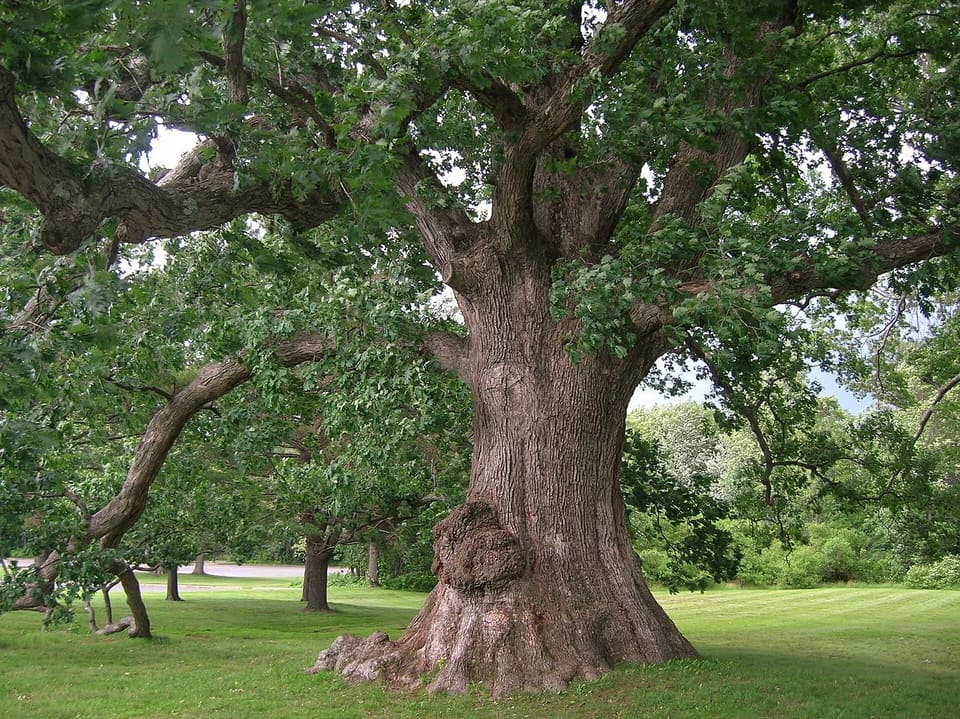

About the plant
What it is and where it grows — not part of any germination protocol.
Safety
- Toxicity
- Poisonous to horse, cattle. Acorns, young leaves. Gallotannins, quercitrin, and quercitin. Stated for Quercus spp.Plants Poisonous to Livestock
- Toxicity
- Low severity. Leaves, Seeds. Gallotannins, quercitrin, and quercitin.Extension Gardener Plant Toolbox
The plant
- Habit
- TreePlant Finder
- Habit
- treePlants of the World Online
- Height
- 50-80 ft15-24 mPlant Finder
- Spread
- 50-80 ft15-24 mPlant Finder
- Flower
- Insignificant; yellowish-greenPlant Finder
- Blooms
- MayPlant Finder
- Native range
- Eastern United StatesPlant Finder
- Hardiness zones
- 3-9Plant Finder
- Note
- The 20% that failed were grub-infested. Germination was 100% for acorns free of grubs.Seed Germination Theory and Practice, 2nd ed.
Growing conditions
- Sun
- Full sunPlant Finder
- Soil
- Rich, moist, acidic, well-drained loamPlant Finder
- Soil pH
- Acid (<6.0)Extension Gardener Plant Toolbox
- Moisture
- Dry to mediumPlant Finder
- Watering
- Dry to mediumPlant Finder
Toxicity is noted only where a source states it. No note here is not a finding of safety.
Sources: Plant Finder — Missouri Botanical Garden; Plants of the World Online — Royal Botanic Gardens, Kew; Extension Gardener Plant Toolbox — NC State Extension; Plants Poisonous to Livestock — Cornell University Department of Animal Science; Seed Germination Theory and Practice, 2nd ed. — N. C. Deno.
Worth knowing
- Sometimes called stave oak: its wood makes tight barrels for whiskey and wine, and it went into ships in colonial times. Lady Bird Johnson Wildflower Center: Quercus alba
- The largest white oak on record, the Wye Oak in Maryland, measured 32 feet around. A storm brought it down on June 6, 2002. Lady Bird Johnson Wildflower Center: Quercus alba
This source reports three treatments. All are shown.
Protocol 1
DerivedN. C. Deno, 1993Difficulty Low
Start around March 15, 2027 for a May 3 last frost.
Sow and cover
Temperature: 70°F 21°C
A stem with true leaves follows in 1-2 weeks. Germination is hypogeal.
No stated waiting before sowing. Then 21 days to germinate.
80% germination in 7–21 days.
Warmth, and nothing else. The 20% that failed were grub-infested; grub-free seed was 100%.
Protocol 2
DerivedN. C. Deno, 1993Difficulty Low
Start around March 1, 2027 for a May 3 last frost.
Cold moist stratification
Temperature: 40°F 4°C
Germination happens during step 1, in 35 days.
80% germination in 7–35 days.
Cold is only slightly slower than warm, and gives the same 80%.
Protocol 3
DerivedN. C. Deno, 1993Difficulty Low
Sow around October 1, 2027 — a date the source gives, not one counted back from a May 3 last frost. Too late for spring 2027 — that needed starting on October 1, 2026.
Sow outdoors and leave it
Started October 1.
No stated waiting before sowing. Germination time not stated; 21 days assumed.
80% germination.
Sown outdoors on October 1 it matched sowing at 70, because October stayed warm.
How each step is done, in Deno’s words, and what Verified and Derived mean.
Germination trials
Readers’ own records of sowing this species, published after review. Share your trial · All trials
No trials shared for this species yet.