Deno’s GardenMy Garden

Clematis connata

Himalayan Clematis

Family RanunculaceaeGenus Clematis

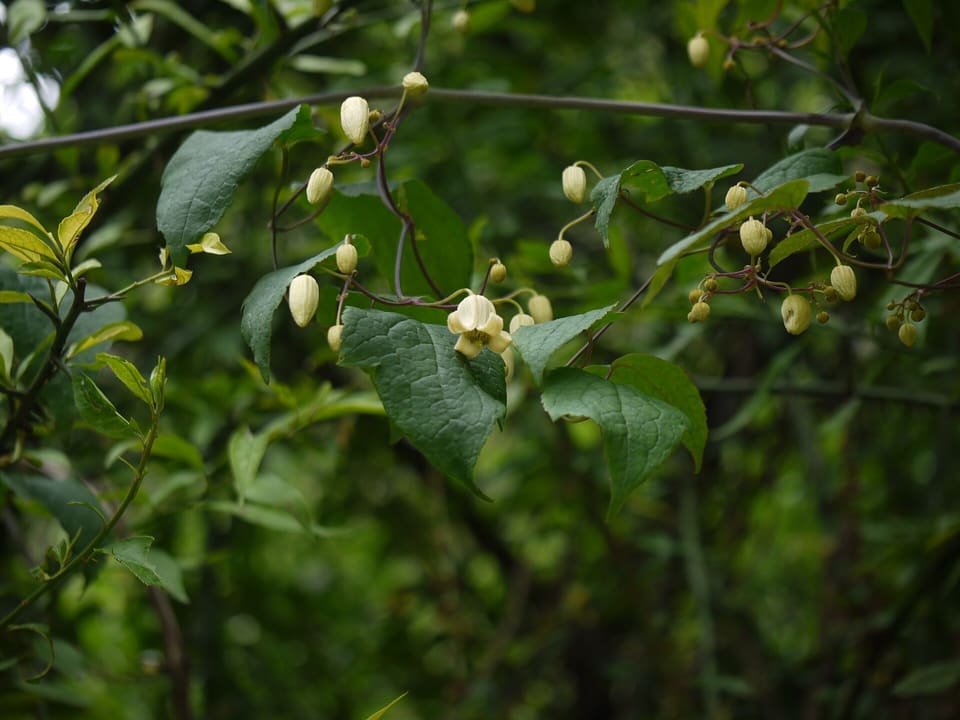
Pale yellow bell flowers hanging on slender stalks along a woody vine with broad pointed leaves
FlowerDinesh Valke from Thane, IndiaCC BY-SA 2.0

About the plant

What it is and where it grows — not part of any germination protocol.

Habit
climberPlants of the World Online
Flower
YellowishFlora of China
Native range
China South-Central, East Himalaya, Myanmar, Nepal, Pakistan, Tibet and elsewhereGBIF Backbone Taxonomy

Toxicity is noted only where a source states it. No note here is not a finding of safety.

Sources: Plants of the World Online — Royal Botanic Gardens, Kew; Flora of China — Wu Zhengyi, Peter H. Raven and Hong Deyuan (eds.); GBIF Backbone Taxonomy — Global Biodiversity Information Facility.

This source reports two treatments. Both are shown.

Protocol 1

DerivedN. C. Deno, 1993

Difficulty High Rated by us, not by the source.

Start around February 22, 2027 for a May 3 last frost.

  1. Warm moist stratification

    Duration: 90 daysTemperature: 70°F 21°C

  2. Cold moist stratification

    Duration: 90 daysTemperature: 40°F 4°C

  3. Warm moist stratification

    Duration: 90 daysTemperature: 70°F 21°C

    1 germinated in this phase.

Steps after step 1 run on after germination.

Germination happens during step 1, in 42 days.

14% germination in 14–42 days.

Seed Germination Theory and Practice, 2nd ed. — N. C. Deno, 1993 · Ch. 20, Clematis p. 119Public domain
Show the original text
Clematis (Ranunculaceae). Light and/or GA-3 are required for the germination of some species. Although a number of species germ. significantly in the dark, light and GA-3 needs to be tried on all species. Multicycle patterns were common and some species germ. largely at 40. The seeds of all species are designed to be dispersed by wind so that it was presumed that DS would be tolerated. This was supported by the data for seeds DS 6 m, however seeds of C. connata germ. 40(6% in 12th w)-70(12% in 3-20 d) and 70(14% in 2-6 w)-40- 70(1% in 3rd w). After 10 in this last cycle the seed was shifted to light whereupon 9% germ. in 4th w suggesting that germination might have been greater if the seed had been given 70L directly. It is likely that DS is not tolerated well because not only was germination low in the above sample, but another sample totally rotted in all treatments.
Seed Germination Theory and Practice, 2nd ed., Ch. 20, Clematis p. 119. Quoted exactly. Every value on this card comes from this record, except the difficulty rating, which is ours; the step names come from a fixed list.

Protocol 2

DerivedN. C. Deno, 1993

Difficulty High Rated by us, not by the source.

Start around December 16, 2026 for a May 3 last frost.

  1. Cold moist stratification

    Duration: 90 daysTemperature: 40°F 4°C

    6 germinated in this phase.

  2. Warm moist stratification

    Duration: 90 daysTemperature: 70°F 21°C

about 3 months from start to step 2. Germination happens during step 2, in 20 days.

12% germination in 3–20 days.

Seed Germination Theory and Practice, 2nd ed. — N. C. Deno, 1993 · Ch. 20, Clematis p. 119Public domain
Show the original text
Clematis (Ranunculaceae). Light and/or GA-3 are required for the germination of some species. Although a number of species germ. significantly in the dark, light and GA-3 needs to be tried on all species. Multicycle patterns were common and some species germ. largely at 40. The seeds of all species are designed to be dispersed by wind so that it was presumed that DS would be tolerated. This was supported by the data for seeds DS 6 m, however seeds of C. connata germ. 40(6% in 12th w)-70(12% in 3-20 d) and 70(14% in 2-6 w)-40- 70(1% in 3rd w). After 10 in this last cycle the seed was shifted to light whereupon 9% germ. in 4th w suggesting that germination might have been greater if the seed had been given 70L directly. It is likely that DS is not tolerated well because not only was germination low in the above sample, but another sample totally rotted in all treatments.
Seed Germination Theory and Practice, 2nd ed., Ch. 20, Clematis p. 119. Quoted exactly. Every value on this card comes from this record, except the difficulty rating, which is ours; the step names come from a fixed list.

Germination trials

Readers’ own records of sowing this species, published after review. Share your trial · All trials

Add to My Garden

View species page