Deno’s GardenMy Garden

Clematis viorna

Vase-vine Leatherflower · Leather-flower · Leather-flower Vine · Vasevine

Family RanunculaceaeGenus Clematis

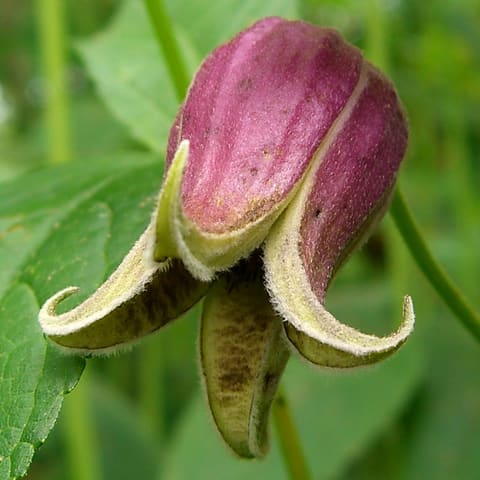
A close view of a thick pink urn-shaped flower, its cream tips rolled back to show the speckled inside
FlowerJason HollingerCC BY 2.0

About the plant

What it is and where it grows — not part of any germination protocol.

The plant

Habit
Ground Cover, Herbaceous Perennial, Perennial, VineExtension Gardener Plant Toolbox
Habit
climberPlants of the World Online
Flower
Purple/Lavender, Red/BurgundyExtension Gardener Plant Toolbox
Blooms
Spring, SummerExtension Gardener Plant Toolbox
Native range
Native to the lower 48 statesPLANTS Database
Hardiness zones
4-9Extension Gardener Plant Toolbox

Growing conditions

Sun
Dappled Sunlight; Partial ShadeExtension Gardener Plant Toolbox
Soil
Clay, High Organic Matter, Loam (Silt), SandExtension Gardener Plant Toolbox
Soil pH
Neutral (6.0-8.0)Extension Gardener Plant Toolbox
Moisture
Good Drainage, MoistExtension Gardener Plant Toolbox

Toxicity is noted only where a source states it. No note here is not a finding of safety.

Sources: Extension Gardener Plant Toolbox — NC State Extension; Plants of the World Online — Royal Botanic Gardens, Kew; PLANTS Database — USDA NRCS.

This source reports three treatments. All are shown.

Protocol 1

DerivedN. C. Deno, 1993

Difficulty Low Rated by us, not by the source.

Start around February 1, 2027 for a May 3 last frost.

  1. Sow and cover

    Temperature: 70°F 21°C Light: dark

No stated waiting before sowing. Then 63 days to germinate.

70% germination in 63 days.

Seed Germination Theory and Practice, 2nd ed. — N. C. Deno, 1993 · Ch. 20, Clematis p. 119Public domain
Show the original text
Clematis (Ranunculaceae). Light and/or GA-3 are required for the germination of some species. Although a number of species germ. significantly in the dark, light and GA-3 needs to be tried on all species. Multicycle patterns were common and some species germ. largely at 40. The seeds of all species are designed to be dispersed by wind so that it was presumed that DS would be tolerated. This was supported by the data for seeds DS 6 m, however seeds of C. viorna germ. 70D(7/10 in 9th w), 70L (9/23 in 8-12 w), and 40-70-40-70(67% in 8-12 w). The small sample makes the small effect of light questionable. Sowing at 40 gives delayed germination.
Seed Germination Theory and Practice, 2nd ed., Ch. 20, Clematis p. 119. Quoted exactly. Every value on this card comes from this record, except the difficulty rating, which is ours; the step names come from a fixed list.

Protocol 2

DerivedN. C. Deno, 1993

Difficulty High Rated by us, not by the source.

Start around April 17, 2027 for a May 3 last frost. Too late for spring 2027 — that needed starting on April 16, 2026.

  1. Cold moist stratification

    Duration: 90 daysTemperature: 40°F 4°C

  2. Warm moist stratification

    Duration: 90 daysTemperature: 70°F 21°C

  3. Cold moist stratification

    Duration: 90 daysTemperature: 40°F 4°C

  4. Warm moist stratification

    Duration: 90 daysTemperature: 70°F 21°C

about 9 months from start to step 4. Germination happens during step 4, in 84 days.

67% germination in 56–84 days.

Seed Germination Theory and Practice, 2nd ed. — N. C. Deno, 1993 · Ch. 20, Clematis p. 119Public domain
Show the original text
Clematis (Ranunculaceae). Light and/or GA-3 are required for the germination of some species. Although a number of species germ. significantly in the dark, light and GA-3 needs to be tried on all species. Multicycle patterns were common and some species germ. largely at 40. The seeds of all species are designed to be dispersed by wind so that it was presumed that DS would be tolerated. This was supported by the data for seeds DS 6 m, however seeds of C. viorna germ. 70D(7/10 in 9th w), 70L (9/23 in 8-12 w), and 40-70-40-70(67% in 8-12 w). The small sample makes the small effect of light questionable. Sowing at 40 gives delayed germination.
Seed Germination Theory and Practice, 2nd ed., Ch. 20, Clematis p. 119. Quoted exactly. Every value on this card comes from this record, except the difficulty rating, which is ours; the step names come from a fixed list.

Protocol 3

DerivedN. C. Deno, 1993

Difficulty Moderate Rated by us, not by the source.

Start around January 11, 2027 for a May 3 last frost.

  1. Sow and cover

    Temperature: 70°F 21°C Light: light

No stated waiting before sowing. Then 84 days to germinate.

39% germination in 56–84 days.

Seed Germination Theory and Practice, 2nd ed. — N. C. Deno, 1993 · Ch. 20, Clematis p. 119Public domain
Show the original text
Clematis (Ranunculaceae). Light and/or GA-3 are required for the germination of some species. Although a number of species germ. significantly in the dark, light and GA-3 needs to be tried on all species. Multicycle patterns were common and some species germ. largely at 40. The seeds of all species are designed to be dispersed by wind so that it was presumed that DS would be tolerated. This was supported by the data for seeds DS 6 m, however seeds of C. viorna germ. 70D(7/10 in 9th w), 70L (9/23 in 8-12 w), and 40-70-40-70(67% in 8-12 w). The small sample makes the small effect of light questionable. Sowing at 40 gives delayed germination.
Seed Germination Theory and Practice, 2nd ed., Ch. 20, Clematis p. 119. Quoted exactly. Every value on this card comes from this record, except the difficulty rating, which is ours; the step names come from a fixed list.

Germination trials

Readers’ own records of sowing this species, published after review. Share your trial · All trials

Add to My Garden

View species page