Deno’s GardenMy Garden

Clematis occidentalis

Northern Blue Clematis · Purple Clematis · Purple Virgin's-bower · Western Blue Virginsbower

Family RanunculaceaeGenus Clematis

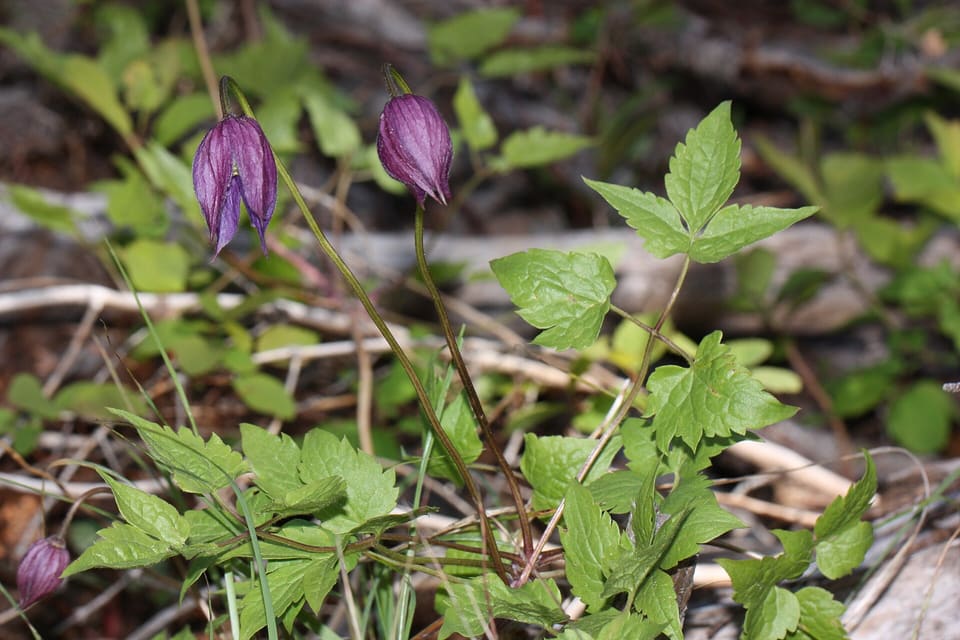
Two nodding deep purple bells on upright stalks above fresh three-parted leaves, on woodland litter
FlowerWalter Siegmund (talk)CC BY-SA 3.0

About the plant

What it is and where it grows — not part of any germination protocol.

Habit
climberPlants of the World Online
Habit
Perennial, VinePLANTS Database
Flower
Violet-blue, reddish violet, whiteFlora of North America
Native range
Canada, lower 48 statesPLANTS Database

Toxicity is noted only where a source states it. No note here is not a finding of safety.

Sources: Plants of the World Online — Royal Botanic Gardens, Kew; PLANTS Database — USDA NRCS; Flora of North America — Flora of North America Editorial Committee.

This source reports three treatments. All are shown.

Protocol 1

DerivedN. C. Deno, 1993

Difficulty Moderate Rated by us, not by the source.

  1. Sow outdoors and leave it

    Up in April.

No stated waiting before sowing.

60% germination.

This source doesn't state how long step 1 lasts.

Seed Germination Theory and Practice, 2nd ed. — N. C. Deno, 1993 · Ch. 20, Clematis p. 119Public domain
Show the original text
Clematis (Ranunculaceae). Light and/or GA-3 are required for the germination of some species. Although a number of species germ. significantly in the dark, light and GA-3 needs to be tried on all species. Multicycle patterns were common and some species germ. largely at 40. The seeds of all species are designed to be dispersed by wind so that it was presumed that DS would be tolerated. This was supported by the data for seeds DS 6 m, however seeds of C. occidentalis germ. 70(24% in 1-4 w)-40(30% in 2-6 w), 40(33% in 8-10 w)- 70(44% in 5-7 w), and 60% in April in outdoor treatment. Light had no effect.
Seed Germination Theory and Practice, 2nd ed., Ch. 20, Clematis p. 119. Quoted exactly. Every value on this card comes from this record, except the difficulty rating, which is ours; the step names come from a fixed list.

Protocol 2

DerivedN. C. Deno, 1993

Difficulty Moderate Rated by us, not by the source.

Start around November 17, 2026 for a May 3 last frost.

  1. Cold moist stratification

    Duration: 90 daysTemperature: 40°F 4°C Light: either

    33 germinated in this phase.

  2. Warm moist stratification

    Duration: 90 daysTemperature: 70°F 21°C Light: either

about 3 months from start to step 2. Germination happens during step 2, in 49 days.

44% germination in 35–49 days.

Seed Germination Theory and Practice, 2nd ed. — N. C. Deno, 1993 · Ch. 20, Clematis p. 119Public domain
Show the original text
Clematis (Ranunculaceae). Light and/or GA-3 are required for the germination of some species. Although a number of species germ. significantly in the dark, light and GA-3 needs to be tried on all species. Multicycle patterns were common and some species germ. largely at 40. The seeds of all species are designed to be dispersed by wind so that it was presumed that DS would be tolerated. This was supported by the data for seeds DS 6 m, however seeds of C. occidentalis germ. 70(24% in 1-4 w)-40(30% in 2-6 w), 40(33% in 8-10 w)- 70(44% in 5-7 w), and 60% in April in outdoor treatment. Light had no effect.
Seed Germination Theory and Practice, 2nd ed., Ch. 20, Clematis p. 119. Quoted exactly. Every value on this card comes from this record, except the difficulty rating, which is ours; the step names come from a fixed list.

Protocol 3

DerivedN. C. Deno, 1993

Difficulty Moderate Rated by us, not by the source.

Start around November 24, 2026 for a May 3 last frost.

  1. Warm moist stratification

    Duration: 90 daysTemperature: 70°F 21°C Light: either

    24 germinated in this phase.

  2. Cold moist stratification

    Duration: 90 daysTemperature: 40°F 4°C Light: either

about 3 months from start to step 2. Germination happens during step 2, in 42 days.

30% germination in 14–42 days.

Seed Germination Theory and Practice, 2nd ed. — N. C. Deno, 1993 · Ch. 20, Clematis p. 119Public domain
Show the original text
Clematis (Ranunculaceae). Light and/or GA-3 are required for the germination of some species. Although a number of species germ. significantly in the dark, light and GA-3 needs to be tried on all species. Multicycle patterns were common and some species germ. largely at 40. The seeds of all species are designed to be dispersed by wind so that it was presumed that DS would be tolerated. This was supported by the data for seeds DS 6 m, however seeds of C. occidentalis germ. 70(24% in 1-4 w)-40(30% in 2-6 w), 40(33% in 8-10 w)- 70(44% in 5-7 w), and 60% in April in outdoor treatment. Light had no effect.
Seed Germination Theory and Practice, 2nd ed., Ch. 20, Clematis p. 119. Quoted exactly. Every value on this card comes from this record, except the difficulty rating, which is ours; the step names come from a fixed list.

Germination trials

Readers’ own records of sowing this species, published after review. Share your trial · All trials

Add to My Garden

View species page