Kalmia latifolia
Calico Bush · Clamoun · Ivybush · Mountain Laurel
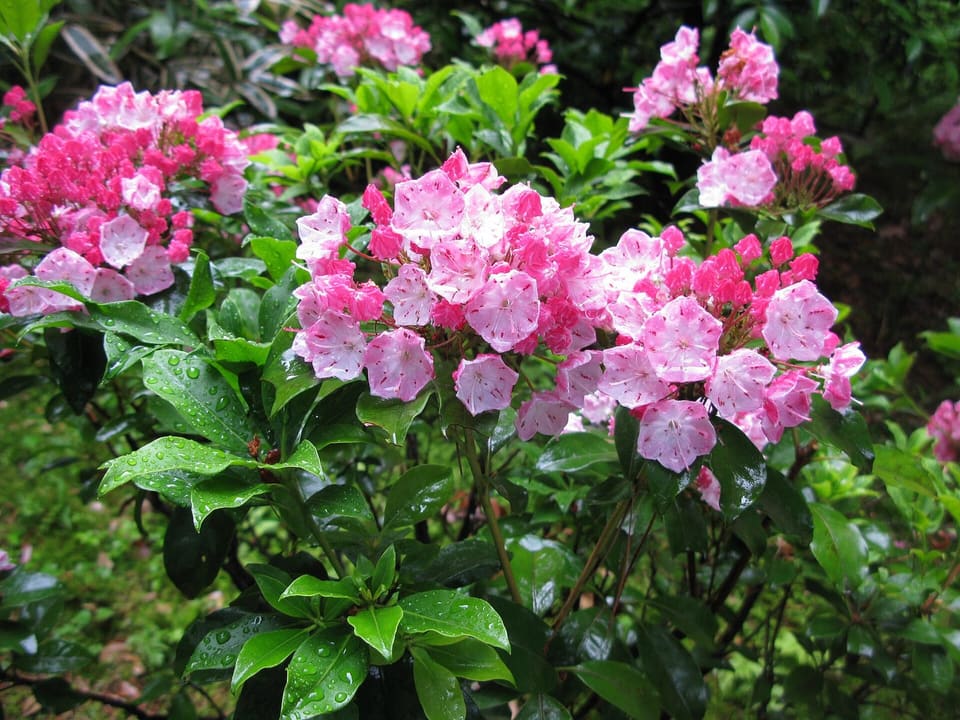

About the plant
What it is and where it grows — not part of any germination protocol.
Safety
- Toxicity
- High severity. All parts. Andromedotoxin, a resinoid; arbutin, a glycoside, Grayanotoxins.Extension Gardener Plant Toolbox
The plant
- Habit
- Broadleaf evergreenPlant Finder
- Habit
- shrubPlants of the World Online
- Height
- 5-15 ft1.5-4.6 mPlant Finder
- Spread
- 5-15 ft1.5-4.6 mPlant Finder
- Flower
- Showy; rose to white with purple markingsPlant Finder
- Blooms
- MayPlant Finder
- Native range
- Eastern United StatesPlant Finder
- Hardiness zones
- 4-9Plant Finder
- Note
- Deno warns his counts are rough: the seed is tiny and hard to separate from the crushed capsule.Seed Germination Theory and Practice, 2nd ed.
Growing conditions
- Sun
- Part shadePlant Finder
- Soil
- Cool, moist, rich, acidic, humusy, well-drainedPlant Finder
- Soil pH
- Acid (<6.0)Extension Gardener Plant Toolbox
- Moisture
- Good Drainage, Moist, Occasionally DryExtension Gardener Plant Toolbox
- Watering
- MediumPlant Finder
Toxicity is noted only where a source states it. No note here is not a finding of safety.
Sources: Plant Finder — Missouri Botanical Garden; Plants of the World Online — Royal Botanic Gardens, Kew; Extension Gardener Plant Toolbox — NC State Extension; Seed Germination Theory and Practice, 2nd ed. — N. C. Deno.
Worth knowing
- The stamens work like springs: a visiting bee trips them and they spread pollen. Lady Bird Johnson Wildflower Center: Kalmia latifolia
- Linnaeus named the genus for his student Peter Kalm, a Swedish botanist who traveled in Canada and the eastern United States. Lady Bird Johnson Wildflower Center: Kalmia latifolia
- Every part is highly toxic. Its burls were carved into briar tobacco pipes. Lady Bird Johnson Wildflower Center: Kalmia latifolia
This source reports 4 treatments. All are shown.
Protocol 1
DerivedN. C. Deno, 1993Difficulty Low
Start around February 22, 2027 for a May 3 last frost.
Separate the seed from its case
Crush the hard capsule so light can reach the seed.
Sow on the surface — do not cover
Temperature: 70°F 21°C Light: light
No stated waiting before sowing. Then 42 days to germinate.
95% germination in 28–42 days.
Crush the capsule, sow on the surface, give it light. That is the entire protocol.
Protocol 2
DerivedN. C. Deno, 1993Difficulty High
Start around December 15, 2026 for a May 3 last frost.
Separate the seed from its case
Crush the hard capsule so light can reach the seed.
Cold moist stratification
Duration: 90 daysTemperature: 40°F 4°C
Deno gives no length for this period; three months is his standard cycle.
Warm moist stratification
Temperature: 70°F 21°C Light: dark
about 3 months from start to step 3. Germination happens during step 3; time not stated, 21 days assumed.
4% germination.
Cold buys a token 4% in the dark. In light it changes nothing at all.
Protocol 3
DerivedN. C. Deno, 1993Difficulty Very high
Start around December 15, 2026 for a May 3 last frost.
Cold moist stratification
Duration: 90 daysTemperature: 40°F 4°C
Warm moist stratification
Duration: 90 daysTemperature: 70°F 21°C Light: dark
about 3 months from start to step 2. Germination happens during step 2; time not stated, 21 days assumed.
4% germination.
Protocol 4
DerivedN. C. Deno, 1993Separate the seed from its case
Crush the hard capsule so light can reach the seed.
Sow and cover
Temperature: 70°F 21°C Light: dark
No stated waiting before sowing.
0% germination.
Nothing in the dark, from fresh seed or after six months' dry storage.
How each step is done, in Deno’s words, and what Verified and Derived mean.
Germination trials
Readers’ own records of sowing this species, published after review. Share your trial · All trials
No trials shared for this species yet.