+ Add to My Garden
About the plant What it is and where it grows — not part of any germination protocol.
The plant
Habit Herbaceous Perennial Extension Gardener Plant Toolbox
Habit perennial or rhizomatous geophyte Plants of the World Online
Height 2-4 ft 0.6-1.2 m Extension Gardener Plant Toolbox
Spread 0.8-2 ft 25-60 cm Extension Gardener Plant Toolbox
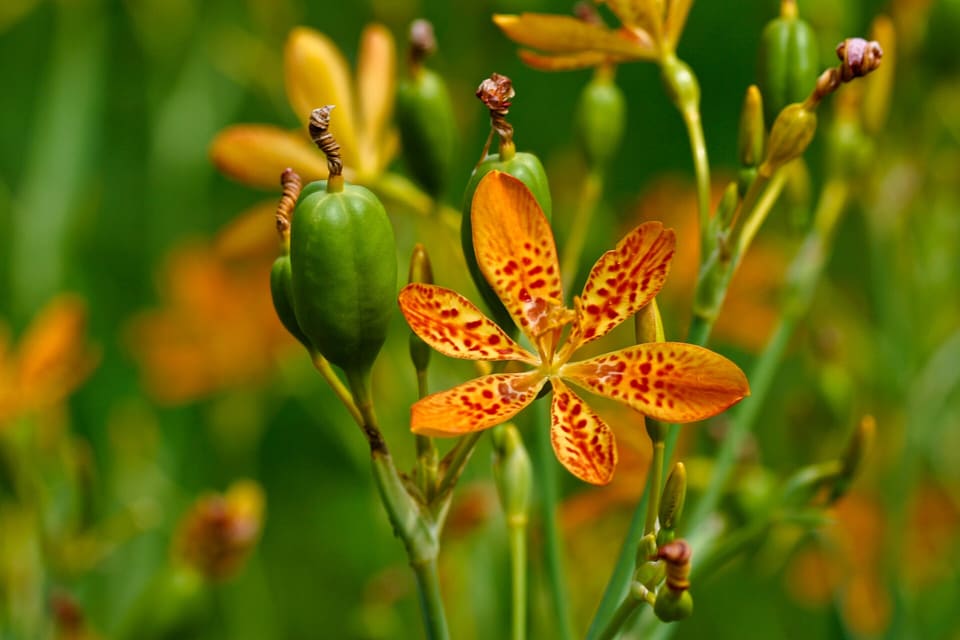
Flower Cream/Tan, Gold/Yellow, Orange, Pink, Purple/Lavender, Red/Burgundy Extension Gardener Plant Toolbox
Blooms Summer Extension Gardener Plant Toolbox
Native range Bangladesh, Cambodia, China North-Central, China South-Central, China Southeast, East Himalaya and elsewhere GBIF Backbone Taxonomy
Hardiness zones 5-10 Extension Gardener Plant Toolbox Growing conditions
Sun Full sun Extension Gardener Plant Toolbox
Soil Clay, Loam (Silt), Sand Extension Gardener Plant Toolbox
Moisture Good Drainage, Moist, Occasionally Dry Extension Gardener Plant Toolbox Toxicity is noted only where a source states it. No note here is not a finding of safety.
Sources: Extension Gardener Plant Toolbox — NC State Extension; Plants of the World Online — Royal Botanic Gardens, Kew; GBIF Backbone Taxonomy — Global Biodiversity Information Facility.
Worth knowing The blackberry lily takes its name from its clusters of black, shiny seeds, which resemble a blackberry when the pods open in fall. Formerly Belamcanda chinensis, it was moved into Iris in 2005 on DNA evidence. Wikipedia: Iris domestica This source reports three treatments. All are shown.
Protocol 1 N. C. Deno, 1993 Difficulty Low Rated by us, not by the source.
1 Clean the flesh off the seed
2 Sow outdoors and leave it
Up in February and March.
No stated waiting before sowing.
75% germination.
This source doesn't state how long step 2 lasts.
Seed Germination Theory and Practice, 2nd ed. — N. C. Deno, 1993 · Ch. 20, Belamcanda p. 106Public domain Show the original text Belamcanda (Iridaceae). B. chinensis seed germ. 70(35-50% in 10-15 d)- 40-70(2%) and 40(6% in 4-8 w). An interesting set of experiments were conducted in which the seed was started at 40 and portions shifted to 70 at w intervals. After the shift to 70 the germination occurred in 3-6 d and percentages were 76%, 44%, and 18% for 4, 8, and 12 w at 40. The unusual result is that 4 w at 40 is beneficial, but further time at 40 leads to steadily decreasing r percent germinations after the shift to 70. Experiments were conducted using seed collected in September; November, and March. There was no marked differences in behavior indicating that DS at 40 is tolerated. Seeds DS for 12Th at 70 germ. nearly as well as fresh seed. Outdoor treatment germ. 75% in February and March. The seed is enclosed in a dryish berry. Seed WO 5 d and seed with no WC gave similar results so that the only value of WC is in giving cleaner seed and less debris. Seed Germination Theory and Practice, 2nd ed., Ch. 20, Belamcanda p. 106. Quoted exactly. Every value on this card comes from this record, except the difficulty rating, which is ours; the step names come from a fixed list. Protocol 2 N. C. Deno, 1993 Difficulty High Rated by us, not by the source.
Start around March 21, 2027 for a May 3 last frost.
1 Clean the flesh off the seed
2 Warm moist stratification
Duration: 90 days · Temperature: 70°F 21°C
3 Cold moist stratification
Duration: 90 days · Temperature: 40°F 4°C
4 Warm moist stratification
Duration: 90 days · Temperature: 70°F 21°C
2 germinated in this phase.
Steps after step 2 run on after germination.
Germination happens during step 2, in 15 days.
35% germination in 10–15 days.
Seed Germination Theory and Practice, 2nd ed. — N. C. Deno, 1993 · Ch. 20, Belamcanda p. 106Public domain Show the original text Belamcanda (Iridaceae). B. chinensis seed germ. 70(35-50% in 10-15 d)- 40-70(2%) and 40(6% in 4-8 w). An interesting set of experiments were conducted in which the seed was started at 40 and portions shifted to 70 at w intervals. After the shift to 70 the germination occurred in 3-6 d and percentages were 76%, 44%, and 18% for 4, 8, and 12 w at 40. The unusual result is that 4 w at 40 is beneficial, but further time at 40 leads to steadily decreasing r percent germinations after the shift to 70. Experiments were conducted using seed collected in September; November, and March. There was no marked differences in behavior indicating that DS at 40 is tolerated. Seeds DS for 12Th at 70 germ. nearly as well as fresh seed. Outdoor treatment germ. 75% in February and March. The seed is enclosed in a dryish berry. Seed WO 5 d and seed with no WC gave similar results so that the only value of WC is in giving cleaner seed and less debris. Seed Germination Theory and Practice, 2nd ed., Ch. 20, Belamcanda p. 106. Quoted exactly. Every value on this card comes from this record, except the difficulty rating, which is ours; the step names come from a fixed list. Protocol 3 N. C. Deno, 1993 Difficulty Very high Rated by us, not by the source.
Start around February 8, 2027 for a May 3 last frost.
1 Clean the flesh off the seed
2 Cold moist stratification
Temperature: 40°F 4°C
Germination happens during step 2, in 56 days.
6% germination in 28–56 days.
Seed Germination Theory and Practice, 2nd ed. — N. C. Deno, 1993 · Ch. 20, Belamcanda p. 106Public domain Show the original text Belamcanda (Iridaceae). B. chinensis seed germ. 70(35-50% in 10-15 d)- 40-70(2%) and 40(6% in 4-8 w). An interesting set of experiments were conducted in which the seed was started at 40 and portions shifted to 70 at w intervals. After the shift to 70 the germination occurred in 3-6 d and percentages were 76%, 44%, and 18% for 4, 8, and 12 w at 40. The unusual result is that 4 w at 40 is beneficial, but further time at 40 leads to steadily decreasing r percent germinations after the shift to 70. Experiments were conducted using seed collected in September; November, and March. There was no marked differences in behavior indicating that DS at 40 is tolerated. Seeds DS for 12Th at 70 germ. nearly as well as fresh seed. Outdoor treatment germ. 75% in February and March. The seed is enclosed in a dryish berry. Seed WO 5 d and seed with no WC gave similar results so that the only value of WC is in giving cleaner seed and less debris. Seed Germination Theory and Practice, 2nd ed., Ch. 20, Belamcanda p. 106. Quoted exactly. Every value on this card comes from this record, except the difficulty rating, which is ours; the step names come from a fixed list. How each step is done , in Deno’s words, and what Verified and Derived mean.
Germination trials Readers’ own records of sowing this species, published after review. Share your trial · All trials
No trials shared for this species yet.