+ Add to My Garden
About the plant What it is and where it grows — not part of any germination protocol.
Habit rhizomatous geophyte Plants of the World Online
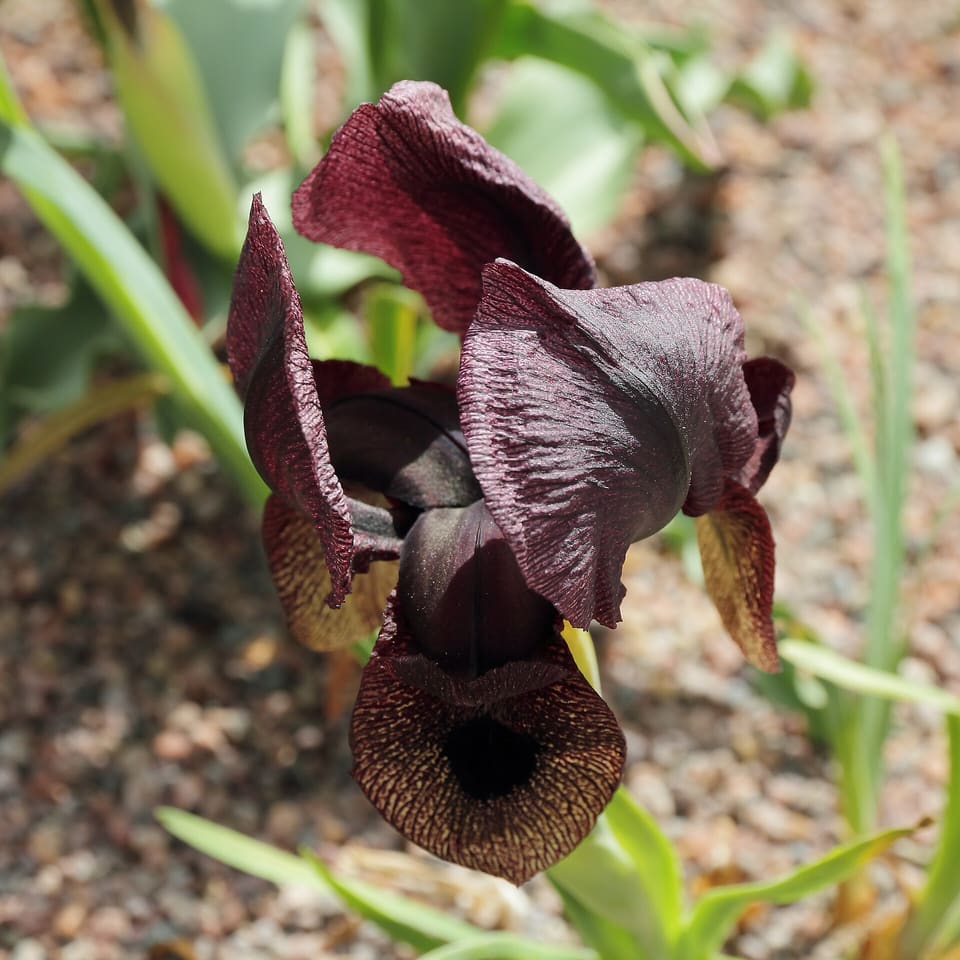
Flower Maroon, black Read from the photograph on this page
Native range Iran, Transcaucasus, Türkiye GBIF Backbone Taxonomy Toxicity is noted only where a source states it. No note here is not a finding of safety.
Sources: Plants of the World Online — Royal Botanic Gardens, Kew; Read from the photograph on this page — Deno's Garden; GBIF Backbone Taxonomy — Global Biodiversity Information Facility.
Worth knowing Rare and endangered in the Caucasus, and thought close to extinct in Armenia. In Georgia, picking it for sale in markets has hurt its populations. Wikipedia: Iris iberica For a May 3 last frost, start this around October 28, 2027 — about 6 months ahead.
This one takes two seasons. Start in October 2027 to plant out in May 2028.
Too late for spring 2027 — that plan needed starting on October 27, 2026. Here is the plan for 2028.
Using a national average last frost of May 3, which is wrong for most places. Put in your zip code for your own dates. Plant words explained .
Protocol N. C. Deno, 1993 Difficulty High Rated by us, not by the source.
1 Warm moist stratification
Duration: 90 days · Temperature: 70°F 21°C
2 Cold moist stratification
Duration: 90 days · Temperature: 40°F 4°C
about 3 months from start to step 2. Germination happens during step 2, in 70 days.
12% germination in 70 days.
Seed Germination Theory and Practice, 2nd ed. — N. C. Deno, 1993 · Ch. 20, Iris p. 156Public domain Show the original text Iris (Iridaceae). This genus gave -not only great diversity in germination behavior but also some of the most extended multicycle germination observed. Germination is always hypogeal, and true leaves develop in 'a week or two once the radicle emerges even when germination was delayed for years. Empty seed coats and deformed seeds are relatively easy to recognize so that seed counts and percent germination are accurate. A major problem is how to stimulate the germination of Oncocyclus and Regelia Iris since they have such extended natural germinations. Panayoti Kelaidis of the Denver Botanical Garden has iritorrmed me that Fritz Kummert In Austria, Frank Norris in Tennessee (USA), and David Shahak in Israel are growing Oncocyclus Iris from seed in large numbers. Panayoti said that there are reports that germination was much improved by rinsing the seed in dilute Chlorox (aqueous NaOCI) and rubbing off the seed coats after which the seeds germ. readily at 40. There are also reports that gibberelic acid and other chemicals stimulate germination. Data is needed using scientific procedures. A recent book, "The Iris" by B. Mathew, is devoted to this genus. Mathew divides the genus into six subgenera with further division into sections and series. His arrangement is used only in part. The species are arranged in alphabetical order for convenience with subgenus or section indicated in parentheses using the abbreviations B (bearded), Bx (beardless), E (Evansia), 'N (Nepalensis), .0 (Oncocyclus), P (Pardanthopsis), A (Regelia), At (Aeticulata), and X (Xiphium). 1. elegantissima (0) was received as wild collected seed from Armenia and from Sevan National Park of USSR. The Armenia seed failed to germinate either after five cycles starting at either 40 or 70 or in outdoor treatment. The'Sevan seed germ. 70- 40(1/8 in 10th w) and 218 in March from placing outdoors in October. The seed started at 70 was shifted to outdoors in October one year later and one germ. the next June. None of those sown at 40 have germ. as yet after 20 m. Seed Germination Theory and Practice, 2nd ed., Ch. 20, Iris p. 156. Quoted exactly. Every value on this card comes from this record, except the difficulty rating, which is ours; the step names come from a fixed list. How each step is done , in Deno’s words, and what Verified and Derived mean.
Germination trials Readers’ own records of sowing this species, published after review. Share your trial · All trials
No trials shared for this species yet.