Deno’s GardenMy Garden

Iris missouriensis

Missouri Flag · Rocky Mountain Iris · Western Blue Flag

Family IridaceaeGenus Iris

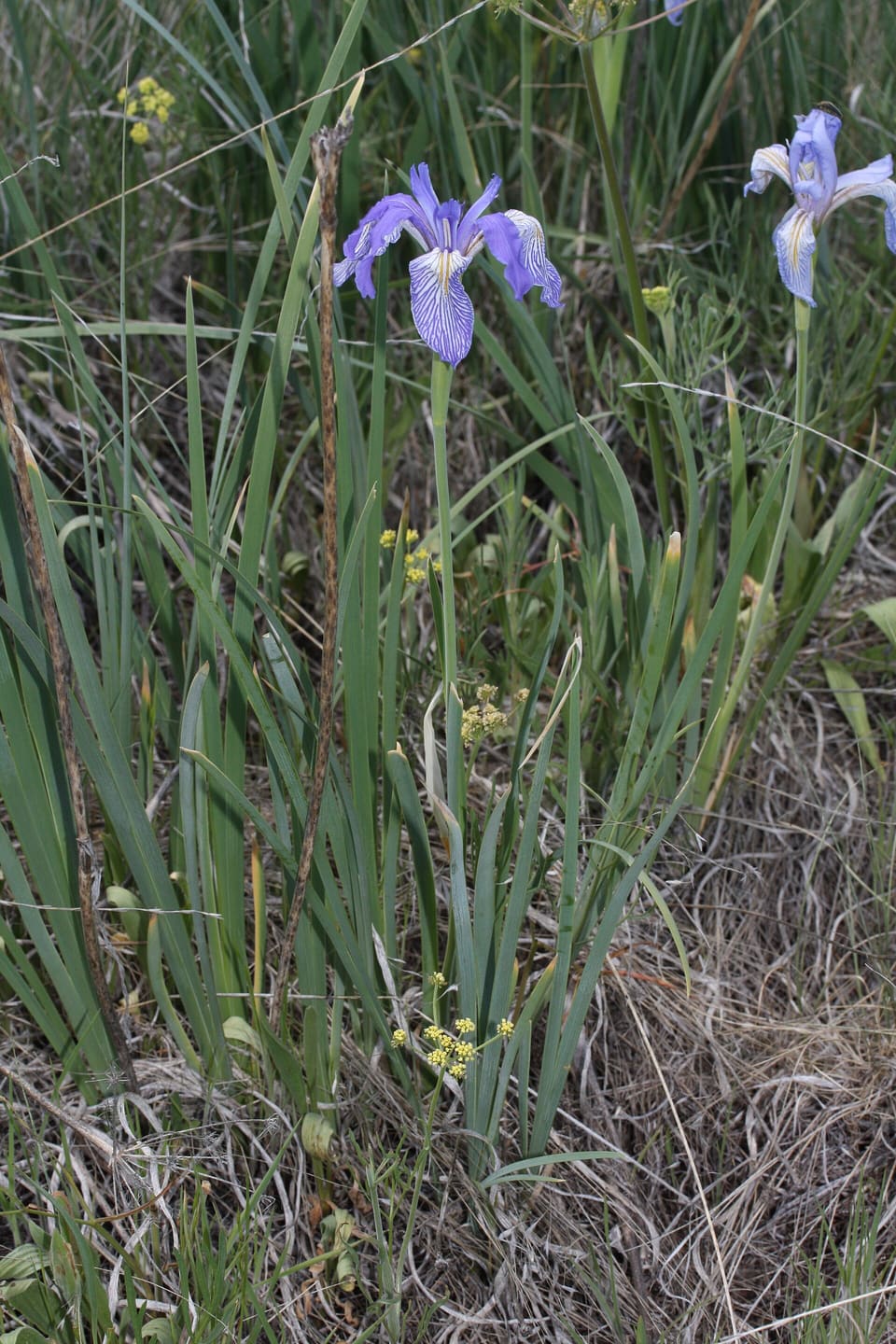
A pale blue iris on a slender stem among meadow grasses and narrow upright leaves
The whole plantWalter Siegmund (talk)CC BY-SA 3.0

About the plant

What it is and where it grows — not part of any germination protocol.

The plant

Habit
rhizomatous geophytePlants of the World Online
Habit
Perennial, Forb/herbPLANTS Database
Height
1.0 ft30 cmPLANTS Database
Flower
PurplePLANTS Database
Blooms
SpringPLANTS Database
Native range
Canada, lower 48 statesPLANTS Database

Growing conditions

Sun
Shade tolerance: MediumPLANTS Database
Soil
Adapted to coarse, medium, fine textured soilsPLANTS Database
Soil pH
7.0-8.5PLANTS Database
Moisture
Moisture use: HighPLANTS Database
Watering
Drought tolerance: LowPLANTS Database

Toxicity is noted only where a source states it. No note here is not a finding of safety.

Sources: Plants of the World Online — Royal Botanic Gardens, Kew; PLANTS Database — USDA NRCS.

Worth knowing

Protocol

DerivedN. C. Deno, 1993

Difficulty Moderate Rated by us, not by the source.

  1. Cold moist stratification

    Duration: 90 daysTemperature: 40°F 4°C

  2. Warm moist stratification

    Duration: 90 daysTemperature: 70°F 21°C Light: light

about 3 months from start to step 2. Germination happens during step 2; time not stated, 21 days assumed.

33% germination.

Seed Germination Theory and Practice, 2nd ed. — N. C. Deno, 1993 · Ch. 20, Iris p. 156Public domain
Show the original text
Iris (Iridaceae). This genus gave -not only great diversity in germination behavior but also some of the most extended multicycle germination observed. Germination is always hypogeal, and true leaves develop in 'a week or two once the radicle emerges even when germination was delayed for years. Empty seed coats and deformed seeds are relatively easy to recognize so that seed counts and percent germination are accurate. A major problem is how to stimulate the germination of Oncocyclus and Regelia Iris since they have such extended natural germinations. Panayoti Kelaidis of the Denver Botanical Garden has iritorrmed me that Fritz Kummert In Austria, Frank Norris in Tennessee (USA), and David Shahak in Israel are growing Oncocyclus Iris from seed in large numbers. Panayoti said that there are reports that germination was much improved by rinsing the seed in dilute Chlorox (aqueous NaOCI) and rubbing off the seed coats after which the seeds germ. readily at 40. There are also reports that gibberelic acid and other chemicals stimulate germination. Data is needed using scientific procedures. A recent book, "The Iris" by B. Mathew, is devoted to this genus. Mathew divides the genus into six subgenera with further division into sections and series. His arrangement is used only in part. The species are arranged in alphabetical order for convenience with subgenus or section indicated in parentheses using the abbreviations B (bearded), Bx (beardless), E (Evansia), 'N (Nepalensis), .0 (Oncocyclus), P (Pardanthopsis), A (Regelia), At (Aeticulata), and X (Xiphium). I. missouriensis (Bx) germ. 70L(219 in 7-10 w), 7013(none), 40-70L(1/3), and 40- 70D(none) suggesting a light requirement. Another sample germ. 2/21 after over 2 y of alternating cycles and 1/23 after 2 y of outdoor treatment. Both samples had been subjected to at least 6 m DS. Treatment with GA-3 has not initiated germination as yet.
Seed Germination Theory and Practice, 2nd ed., Ch. 20, Iris p. 156. Quoted exactly. Every value on this card comes from this record, except the difficulty rating, which is ours; the step names come from a fixed list.

Germination trials

Readers’ own records of sowing this species, published after review. Share your trial · All trials

Add to My Garden

View species page