Deno’s GardenMy Garden

Rumex venosus

Sand Dock · Veined Dock · Veiny Dock

Family PolygonaceaeGenus Rumex

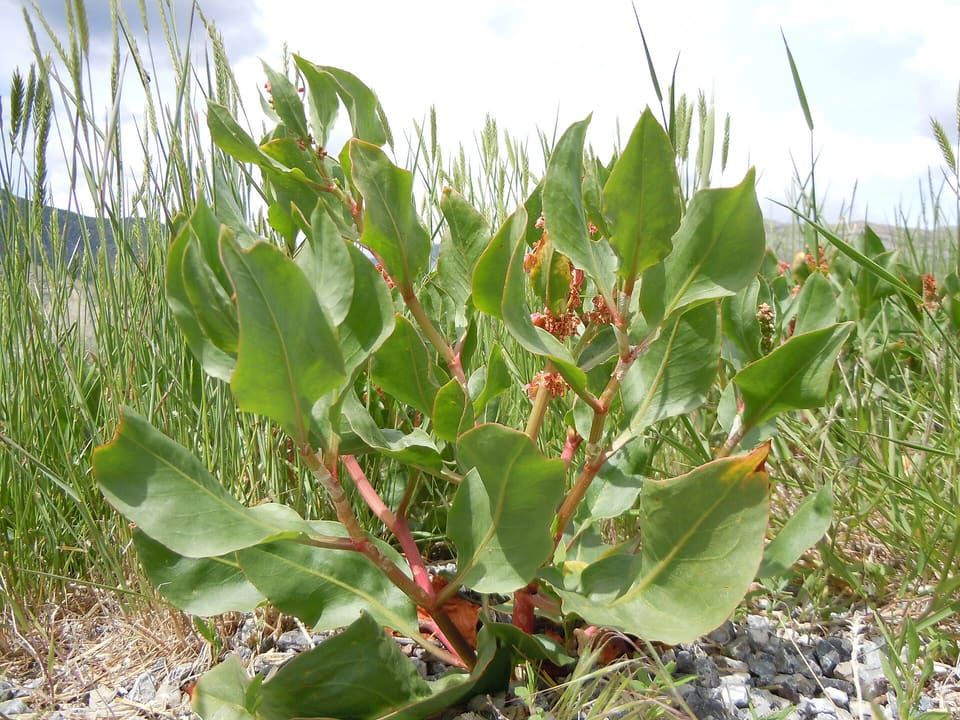
A low bush of thick wavy-edged leaves on red stems, its rusty flower clusters half hidden, among dry grass on a sagebrush flat.
The whole plantMatt Lavin from Bozeman, Montana, USACC BY-SA 2.0

About the plant

What it is and where it grows — not part of any germination protocol.

Habit
perennialPlants of the World Online
Habit
Perennial, Forb/herbPLANTS Database
Flower
GreenWikipedia
Native range
Canada, lower 48 statesPLANTS Database

Toxicity is noted only where a source states it. No note here is not a finding of safety.

Sources: Plants of the World Online — Royal Botanic Gardens, Kew; PLANTS Database — USDA NRCS; Wikipedia — Wikipedia contributors.

Worth knowing

This source reports three treatments. All are shown.

Protocol 1

DerivedN. C. Deno, 1996

Difficulty Low Rated by us, not by the source.

Start around February 1, 2027 for a May 3 last frost.

  1. Cold moist stratification

    Temperature: 40°F 4°C

Germination happens during step 1, in 63 days.

70% germination in 28–63 days.

Seed Germination Theory and Practice, 1st Supplement — N. C. Deno, 1996 · 1st Supplement, Rumex p. 73Public domain
Show the original text
Rumex (Polygonaceae). Some species require light and others do not. The seeds were DS 8 m when received. They were studied when received. They were also studied after DS for 2 y except for R. venosus germ 70 GA-3(43% in 2nd w), 40(70% in 4-9 w), and 65% in April in OT. A prior 3 m in 70D or 70L was fatal and none germ. on shifting to 40.
Seed Germination Theory and Practice, 1st Supplement, 1st Supplement, Rumex p. 73. Quoted exactly. Every value on this card comes from this record, except the difficulty rating, which is ours; the step names come from a fixed list.

Protocol 2

DerivedN. C. Deno, 1996

Difficulty Moderate Rated by us, not by the source.

  1. Sow outdoors and leave it

    Up in April.

No stated waiting before sowing.

65% germination.

This source doesn't state how long step 1 lasts.

Seed Germination Theory and Practice, 1st Supplement — N. C. Deno, 1996 · 1st Supplement, Rumex p. 73Public domain
Show the original text
Rumex (Polygonaceae). Some species require light and others do not. The seeds were DS 8 m when received. They were studied when received. They were also studied after DS for 2 y except for R. venosus germ 70 GA-3(43% in 2nd w), 40(70% in 4-9 w), and 65% in April in OT. A prior 3 m in 70D or 70L was fatal and none germ. on shifting to 40.
Seed Germination Theory and Practice, 1st Supplement, 1st Supplement, Rumex p. 73. Quoted exactly. Every value on this card comes from this record, except the difficulty rating, which is ours; the step names come from a fixed list.

Protocol 3

DerivedN. C. Deno, 1996

Difficulty Moderate Rated by us, not by the source.

Start around March 22, 2027 for a May 3 last frost.

  1. Gibberellic acid soak

  2. Sow and cover

    Temperature: 70°F 21°C

No stated waiting before sowing. Then 14 days to germinate.

43% germination in 14 days.

Seed Germination Theory and Practice, 1st Supplement — N. C. Deno, 1996 · 1st Supplement, Rumex p. 73Public domain
Show the original text
Rumex (Polygonaceae). Some species require light and others do not. The seeds were DS 8 m when received. They were studied when received. They were also studied after DS for 2 y except for R. venosus germ 70 GA-3(43% in 2nd w), 40(70% in 4-9 w), and 65% in April in OT. A prior 3 m in 70D or 70L was fatal and none germ. on shifting to 40.
Seed Germination Theory and Practice, 1st Supplement, 1st Supplement, Rumex p. 73. Quoted exactly. Every value on this card comes from this record, except the difficulty rating, which is ours; the step names come from a fixed list.

Germination trials

Readers’ own records of sowing this species, published after review. Share your trial · All trials

Add to My Garden

View species page