Deno’s GardenMy Garden

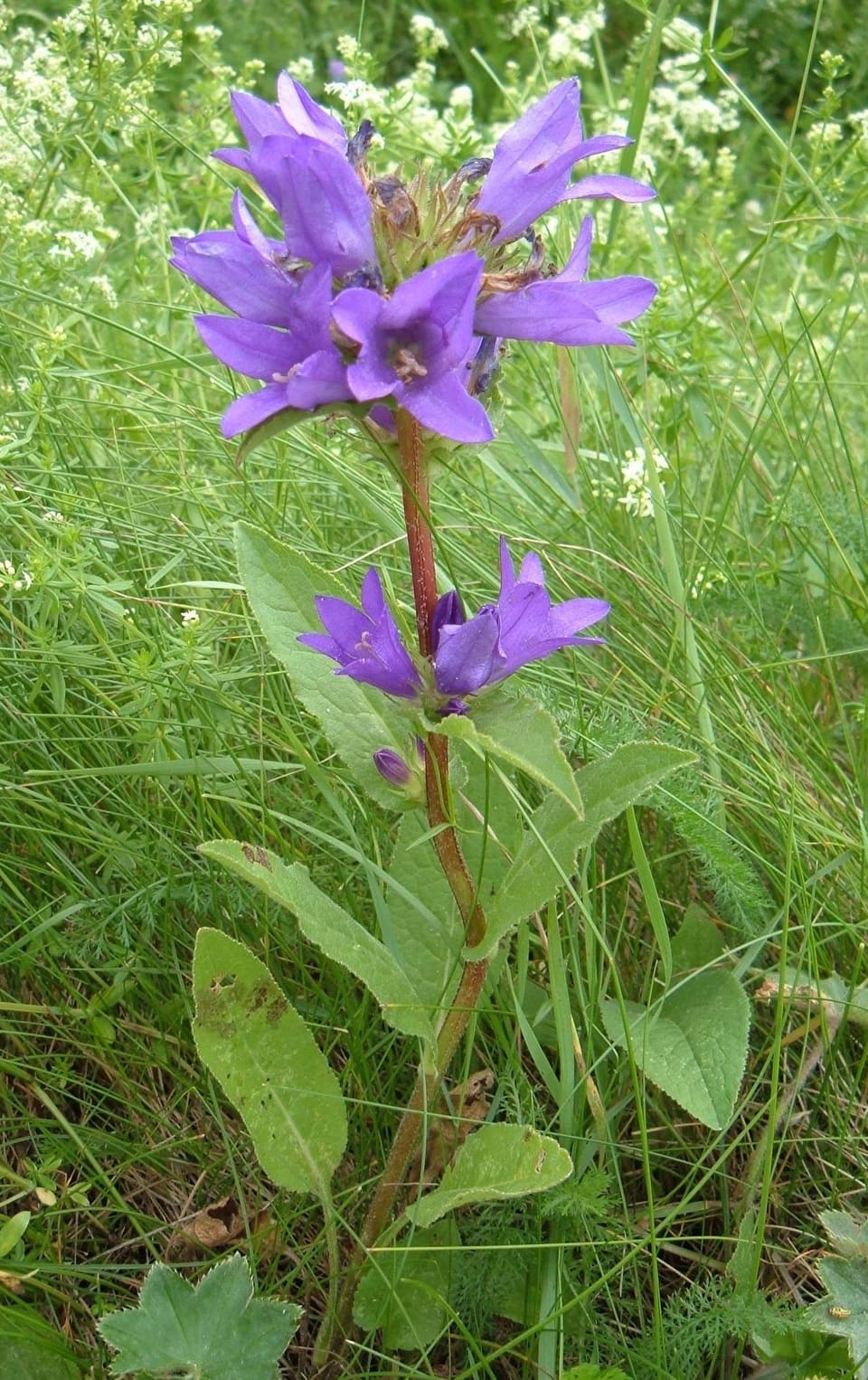
Campanula glomerata

Clustered Bellflower · Dane's Blood
Family CampanulaceaeGenus Campanula

An upright stem with tight clusters of deep violet bell flowers at the top and where the leaves join, in meadow grass
The whole plantDag LindgrenCC BY-SA 3.0

About the plant

What it is and where it grows — not part of any germination protocol.

The plant

Habit
Herbaceous Perennial, PerennialExtension Gardener Plant Toolbox
Habit
perennialPlants of the World Online
Height
1-1.5 ft30-45 cmExtension Gardener Plant Toolbox
Spread
0.5-1 ft15-30 cmExtension Gardener Plant Toolbox
Flower
Blue, Purple/LavenderExtension Gardener Plant Toolbox
Blooms
SummerExtension Gardener Plant Toolbox
Native range
Albania, Altay, Amur, Austria, Baltic States, Belarus and elsewhereGBIF Backbone Taxonomy
Hardiness zones
3-8Extension Gardener Plant Toolbox

Growing conditions

Sun
Full sun; Partial ShadeExtension Gardener Plant Toolbox
Soil
Loam (Silt), SandExtension Gardener Plant Toolbox
Soil pH
Alkaline (>8.0), Neutral (6.0-8.0)Extension Gardener Plant Toolbox
Moisture
Good Drainage, MoistExtension Gardener Plant Toolbox

Toxicity is noted only where a source states it. No note here is not a finding of safety.

Sources: Extension Gardener Plant Toolbox — NC State Extension; Plants of the World Online — Royal Botanic Gardens, Kew; GBIF Backbone Taxonomy — Global Biodiversity Information Facility.

Worth knowing

  • The county flower of Rutland. Campanula means small bell; glomerata refers to the flowers packed together at the top of the stem. Wikipedia: Campanula glomerata

This source reports 4 treatments. All are shown.

Protocol 1

DerivedN. C. Deno, 1993

Difficulty Low Rated by us, not by the source.

Start around February 8, 2027 for a May 3 last frost.

  1. Sow and cover

    Temperature: 70°F 21°C Light: dark

No stated waiting before sowing. Then 56 days to germinate.

97% germination in 7–56 days.

Seed Germination Theory and Practice, 2nd ed. — N. C. Deno, 1993 · Ch. 20, Campanula p. 110Public domain
Show the original text
Campanula (Campanulaceae). Most species are D-70 germinators. There are some that are 40-70 germinators and photorequirers and C. glomerata acaulis germ. 70L(90% in 6-8 d), 70D(97% in 1-8 w), and 40- 70D(none). The slower germination in 70D could have been a temperature effect due to light absorption The complete failure to germinate when started at 40 is striking, and this is a fatal treatment.
Seed Germination Theory and Practice, 2nd ed., Ch. 20, Campanula p. 110. Quoted exactly. Every value on this card comes from this record, except the difficulty rating, which is ours; the step names come from a fixed list.

Protocol 2

DerivedN. C. Deno, 1993

Difficulty Low Rated by us, not by the source.

Start around March 28, 2027 for a May 3 last frost.

  1. Sow and cover

    Temperature: 70°F 21°C Light: light

No stated waiting before sowing. Then 8 days to germinate.

90% germination in 6–8 days.

Seed Germination Theory and Practice, 2nd ed. — N. C. Deno, 1993 · Ch. 20, Campanula p. 110Public domain
Show the original text
Campanula (Campanulaceae). Most species are D-70 germinators. There are some that are 40-70 germinators and photorequirers and C. glomerata acaulis germ. 70L(90% in 6-8 d), 70D(97% in 1-8 w), and 40- 70D(none). The slower germination in 70D could have been a temperature effect due to light absorption The complete failure to germinate when started at 40 is striking, and this is a fatal treatment.
Seed Germination Theory and Practice, 2nd ed., Ch. 20, Campanula p. 110. Quoted exactly. Every value on this card comes from this record, except the difficulty rating, which is ours; the step names come from a fixed list.

Protocol 3

DerivedN. C. Deno, 1993

Difficulty Low Rated by us, not by the source.

Start around March 22, 2027 for a May 3 last frost.

  1. Sow and cover

    Temperature: 70°F 21°C Light: either

No stated waiting before sowing. Then 14 days to germinate.

85% germination in 14 days.

Seed Germination Theory and Practice, 2nd ed. — N. C. Deno, 1993 · Ch. 20, Campanula p. 110Public domain
Show the original text
Campanula (Campanulaceae). Most species are D-70 germinators. There are some that are 40-70 germinators and photorequirers and C. trautvetteri germ. 70(85-90% in 2nd w) and 40(1%)-70 showing that starting at 40 is a fatal treatment. Light had no effect.
Seed Germination Theory and Practice, 2nd ed., Ch. 20, Campanula p. 110. Quoted exactly. Every value on this card comes from this record, except the difficulty rating, which is ours; the step names come from a fixed list.

Protocol 4

DerivedN. C. Deno, 1993

Difficulty Very high Rated by us, not by the source.

Start around March 15, 2027 for a May 3 last frost.

  1. Cold moist stratification

    Duration: 90 daysTemperature: 40°F 4°C Light: either

  2. Warm moist stratification

    Duration: 90 daysTemperature: 70°F 21°C Light: either

Steps after step 1 run on after germination.

Germination happens during step 1; time not stated, 21 days assumed.

1% germination.

Seed Germination Theory and Practice, 2nd ed. — N. C. Deno, 1993 · Ch. 20, Campanula p. 110Public domain
Show the original text
Campanula (Campanulaceae). Most species are D-70 germinators. There are some that are 40-70 germinators and photorequirers and C. trautvetteri germ. 70(85-90% in 2nd w) and 40(1%)-70 showing that starting at 40 is a fatal treatment. Light had no effect.
Seed Germination Theory and Practice, 2nd ed., Ch. 20, Campanula p. 110. Quoted exactly. Every value on this card comes from this record, except the difficulty rating, which is ours; the step names come from a fixed list.

Germination trials

Readers’ own records of sowing this species, published after review. Share your trial · All trials

Add to My Garden

View species page