Deno’s GardenMy Garden

Campanula rapunculoides

Creeping Bellflower · Rampion Bellflower

Family CampanulaceaeGenus Campanula

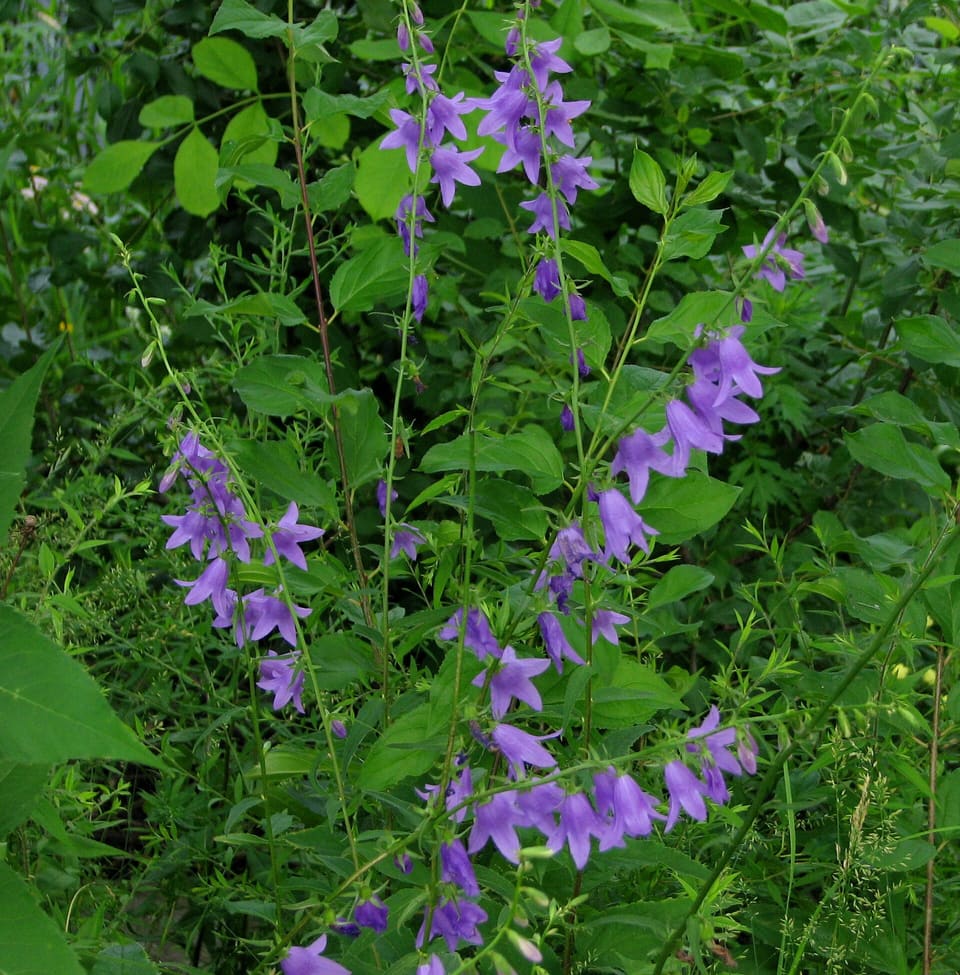
Arching spikes hung with violet bell flowers, all turned to one side, above nettle-like leaves
FlowerD. Gordon E. RobertsonCC BY-SA 3.0

About the plant

What it is and where it grows — not part of any germination protocol.

Habit
perennialPlants of the World Online
Flower
Bright blue-violetWikipedia

Toxicity is noted only where a source states it. No note here is not a finding of safety.

Sources: Plants of the World Online — Royal Botanic Gardens, Kew; Wikipedia — Wikipedia contributors.

Worth knowing

  • Any piece of its root can sprout into a new plant, so it is extremely hard to eradicate; in parts of North America it is extremely invasive. Wikipedia: Campanula rapunculoides

This source reports 4 treatments. All are shown.

Protocol 1

DerivedN. C. Deno, 1993

Difficulty Low Rated by us, not by the source.

Start around October 1, 2027 for a May 3 last frost. Too late for spring 2027 — that needed starting on September 30, 2026.

  1. Dry storage

    Duration: 180 daysTemperature: 70°F 21°C

  2. Sow and cover

    Temperature: 70°F 21°C Light: light

about 6 months from start to sowing. Then 7 days to germinate.

90% germination in 3–7 days.

Seed Germination Theory and Practice, 2nd ed. — N. C. Deno, 1993 · Ch. 20, Campanula p. 110Public domain
Show the original text
Campanula (Campanulaceae). Most species are D-70 germinators. There are some that are 40-70 germinators and photorequirers and C. rapunculoides is like C. americana in that DS 6 m at 70 or 40, an initial 3 m at 40, and light at 70 all promote germination. Omission of either the DS or the 3 m at 40 causes total failure. Germination of 90% can be achieved in the following three ways: fresh seed in 40-70L(90% in 2-4 d), fresh seed in outdoor treatment with germination in February through April, and DS seed in 70L(90% in 3-7 d). Other treatments including certain dark treatments give satisfactory (but not optimum) germination. For example 40-70D(40%) for fresh seed and 70D(60-80%) for DS seed.
Seed Germination Theory and Practice, 2nd ed., Ch. 20, Campanula p. 110. Quoted exactly. Every value on this card comes from this record, except the difficulty rating, which is ours; the step names come from a fixed list.

Protocol 2

DerivedN. C. Deno, 1993

Difficulty Moderate Rated by us, not by the source.

Start around January 1, 2027 for a May 3 last frost.

  1. Cold moist stratification

    Duration: 90 daysTemperature: 40°F 4°C

  2. Warm moist stratification

    Duration: 90 daysTemperature: 70°F 21°C Light: light

about 3 months from start to step 2. Germination happens during step 2, in 4 days.

90% germination in 2–4 days.

Seed Germination Theory and Practice, 2nd ed. — N. C. Deno, 1993 · Ch. 20, Campanula p. 110Public domain
Show the original text
Campanula (Campanulaceae). Most species are D-70 germinators. There are some that are 40-70 germinators and photorequirers and C. rapunculoides is like C. americana in that DS 6 m at 70 or 40, an initial 3 m at 40, and light at 70 all promote germination. Omission of either the DS or the 3 m at 40 causes total failure. Germination of 90% can be achieved in the following three ways: fresh seed in 40-70L(90% in 2-4 d), fresh seed in outdoor treatment with germination in February through April, and DS seed in 70L(90% in 3-7 d). Other treatments including certain dark treatments give satisfactory (but not optimum) germination. For example 40-70D(40%) for fresh seed and 70D(60-80%) for DS seed.
Seed Germination Theory and Practice, 2nd ed., Ch. 20, Campanula p. 110. Quoted exactly. Every value on this card comes from this record, except the difficulty rating, which is ours; the step names come from a fixed list.

Protocol 3

DerivedN. C. Deno, 1993

Difficulty Moderate Rated by us, not by the source.

Start around September 17, 2027 for a May 3 last frost. Too late for spring 2027 — that needed starting on September 16, 2026.

  1. Dry storage

    Duration: 180 daysTemperature: 70°F 21°C

  2. Sow and cover

    Temperature: 70°F 21°C Light: dark

about 6 months from start to sowing. Germination time not stated; 21 days assumed.

60% germination.

Seed Germination Theory and Practice, 2nd ed. — N. C. Deno, 1993 · Ch. 20, Campanula p. 110Public domain
Show the original text
Campanula (Campanulaceae). Most species are D-70 germinators. There are some that are 40-70 germinators and photorequirers and C. rapunculoides is like C. americana in that DS 6 m at 70 or 40, an initial 3 m at 40, and light at 70 all promote germination. Omission of either the DS or the 3 m at 40 causes total failure. Germination of 90% can be achieved in the following three ways: fresh seed in 40-70L(90% in 2-4 d), fresh seed in outdoor treatment with germination in February through April, and DS seed in 70L(90% in 3-7 d). Other treatments including certain dark treatments give satisfactory (but not optimum) germination. For example 40-70D(40%) for fresh seed and 70D(60-80%) for DS seed.
Seed Germination Theory and Practice, 2nd ed., Ch. 20, Campanula p. 110. Quoted exactly. Every value on this card comes from this record, except the difficulty rating, which is ours; the step names come from a fixed list.

Protocol 4

DerivedN. C. Deno, 1993

Difficulty Moderate Rated by us, not by the source.

Start around December 15, 2026 for a May 3 last frost.

  1. Cold moist stratification

    Duration: 90 daysTemperature: 40°F 4°C

  2. Warm moist stratification

    Duration: 90 daysTemperature: 70°F 21°C Light: dark

about 3 months from start to step 2. Germination happens during step 2; time not stated, 21 days assumed.
40% germination.

Seed Germination Theory and Practice, 2nd ed. — N. C. Deno, 1993 · Ch. 20, Campanula p. 110Public domain
Show the original text
Campanula (Campanulaceae). Most species are D-70 germinators. There are some that are 40-70 germinators and photorequirers and C. rapunculoides is like C. americana in that DS 6 m at 70 or 40, an initial 3 m at 40, and light at 70 all promote germination. Omission of either the DS or the 3 m at 40 causes total failure. Germination of 90% can be achieved in the following three ways: fresh seed in 40-70L(90% in 2-4 d), fresh seed in outdoor treatment with germination in February through April, and DS seed in 70L(90% in 3-7 d). Other treatments including certain dark treatments give satisfactory (but not optimum) germination. For example 40-70D(40%) for fresh seed and 70D(60-80%) for DS seed.
Seed Germination Theory and Practice, 2nd ed., Ch. 20, Campanula p. 110. Quoted exactly. Every value on this card comes from this record, except the difficulty rating, which is ours; the step names come from a fixed list.

Germination trials

Readers’ own records of sowing this species, published after review. Share your trial · All trials

Add to My Garden

View species page