Deno’s GardenMy Garden

Campanula scabrella

Downy Alpine Bellflower · Rough Bellflower · Rough Harebell

Family CampanulaceaeGenus Campanula

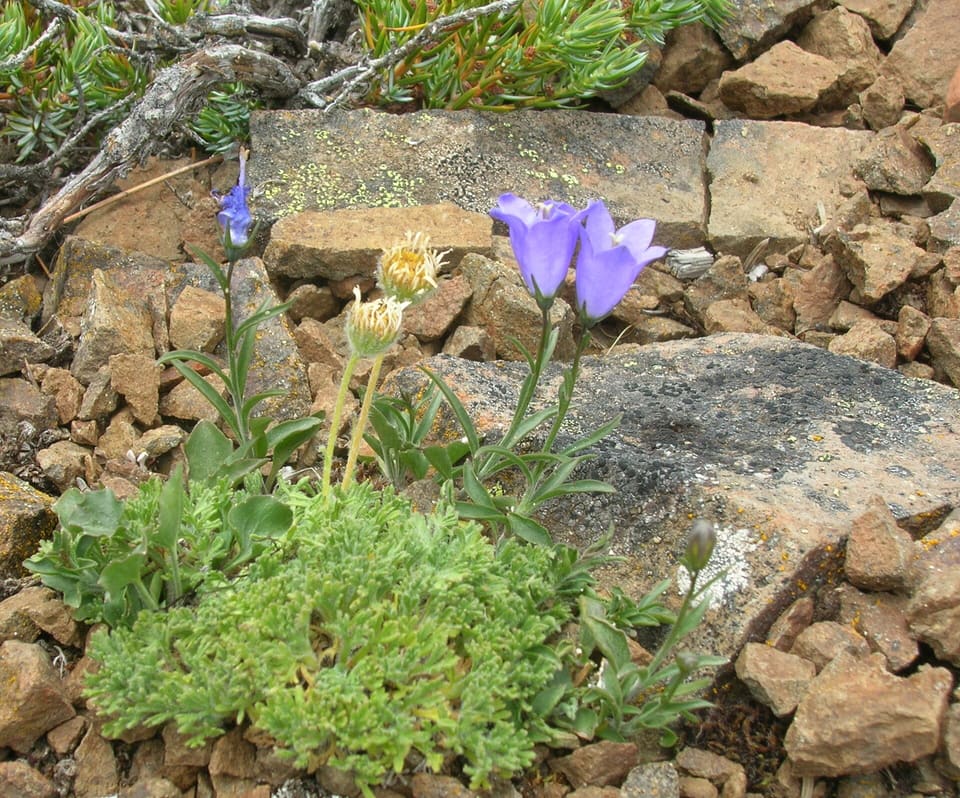
Two upward-facing violet bells on short stems beside a tuft of gray-green leaves, wedged in broken rock
FlowerJ BrewCC BY-SA 2.0

About the plant

What it is and where it grows — not part of any germination protocol.

Habit
perennialPlants of the World Online
Habit
Perennial, Forb/herbPLANTS Database
Flower
Pale blue, lavenderWikipedia
Native range
California, Idaho, Montana, Oregon, WashingtonGBIF Backbone Taxonomy

Toxicity is noted only where a source states it. No note here is not a finding of safety.

Sources: Plants of the World Online — Royal Botanic Gardens, Kew; PLANTS Database — USDA NRCS; Wikipedia — Wikipedia contributors; GBIF Backbone Taxonomy — Global Biodiversity Information Facility.

This source reports three treatments. All are shown.

Protocol 1

DerivedN. C. Deno, 1993

Difficulty Moderate Rated by us, not by the source.

Start around March 22, 2027 for a May 3 last frost.

  1. Gibberellic acid soak

  2. Sow and cover

    Temperature: 70°F 21°C Light: dark

No stated waiting before sowing. Then 14 days to germinate.

56% germination in 14 days.

Seed Germination Theory and Practice, 2nd ed. — N. C. Deno, 1993 · Ch. 20, Campanula p. 110Public domain
Show the original text
Campanula (Campanulaceae). Most species are D-70 germinators. There are some that are 40-70 germinators and photorequirers and C. scabrella germination was strongly promoted either by light or by GA-3. The data are 70L(40% in 2-8 w), 70D GA-3(56% in 2nd w), and 70D(7% in 2-8 w). The seedlings from GA-3 promoted germination were normal, however the GA-3 treatment is unnecessary in view of the good germination in 70L. The above data is for seeds DS one y at 40. Seeds collected from the same source and DS 3 y at 70 germ. 70L(1 1%) and 70D(none) showing that there had been significant deterioration of the seeds in the longer DS. A preliminary 3 m at 40 had no effect.
Seed Germination Theory and Practice, 2nd ed., Ch. 20, Campanula p. 110. Quoted exactly. Every value on this card comes from this record, except the difficulty rating, which is ours; the step names come from a fixed list.

Protocol 2

DerivedN. C. Deno, 1993

Difficulty Moderate Rated by us, not by the source.

Start around February 8, 2027 for a May 3 last frost.

  1. Sow and cover

    Temperature: 70°F 21°C Light: light

No stated waiting before sowing. Then 56 days to germinate.

40% germination in 14–56 days.

Seed Germination Theory and Practice, 2nd ed. — N. C. Deno, 1993 · Ch. 20, Campanula p. 110Public domain
Show the original text
Campanula (Campanulaceae). Most species are D-70 germinators. There are some that are 40-70 germinators and photorequirers and C. scabrella germination was strongly promoted either by light or by GA-3. The data are 70L(40% in 2-8 w), 70D GA-3(56% in 2nd w), and 70D(7% in 2-8 w). The seedlings from GA-3 promoted germination were normal, however the GA-3 treatment is unnecessary in view of the good germination in 70L. The above data is for seeds DS one y at 40. Seeds collected from the same source and DS 3 y at 70 germ. 70L(1 1%) and 70D(none) showing that there had been significant deterioration of the seeds in the longer DS. A preliminary 3 m at 40 had no effect.
Seed Germination Theory and Practice, 2nd ed., Ch. 20, Campanula p. 110. Quoted exactly. Every value on this card comes from this record, except the difficulty rating, which is ours; the step names come from a fixed list.

Protocol 3

DerivedN. C. Deno, 1993

Difficulty Very high Rated by us, not by the source.

Start around February 8, 2027 for a May 3 last frost.

  1. Sow and cover

    Temperature: 70°F 21°C Light: dark

No stated waiting before sowing. Then 56 days to germinate.

7% germination in 14–56 days.

Seed Germination Theory and Practice, 2nd ed. — N. C. Deno, 1993 · Ch. 20, Campanula p. 110Public domain
Show the original text
Campanula (Campanulaceae). Most species are D-70 germinators. There are some that are 40-70 germinators and photorequirers and C. scabrella germination was strongly promoted either by light or by GA-3. The data are 70L(40% in 2-8 w), 70D GA-3(56% in 2nd w), and 70D(7% in 2-8 w). The seedlings from GA-3 promoted germination were normal, however the GA-3 treatment is unnecessary in view of the good germination in 70L. The above data is for seeds DS one y at 40. Seeds collected from the same source and DS 3 y at 70 germ. 70L(1 1%) and 70D(none) showing that there had been significant deterioration of the seeds in the longer DS. A preliminary 3 m at 40 had no effect.
Seed Germination Theory and Practice, 2nd ed., Ch. 20, Campanula p. 110. Quoted exactly. Every value on this card comes from this record, except the difficulty rating, which is ours; the step names come from a fixed list.

Germination trials

Readers’ own records of sowing this species, published after review. Share your trial · All trials

Add to My Garden

View species page